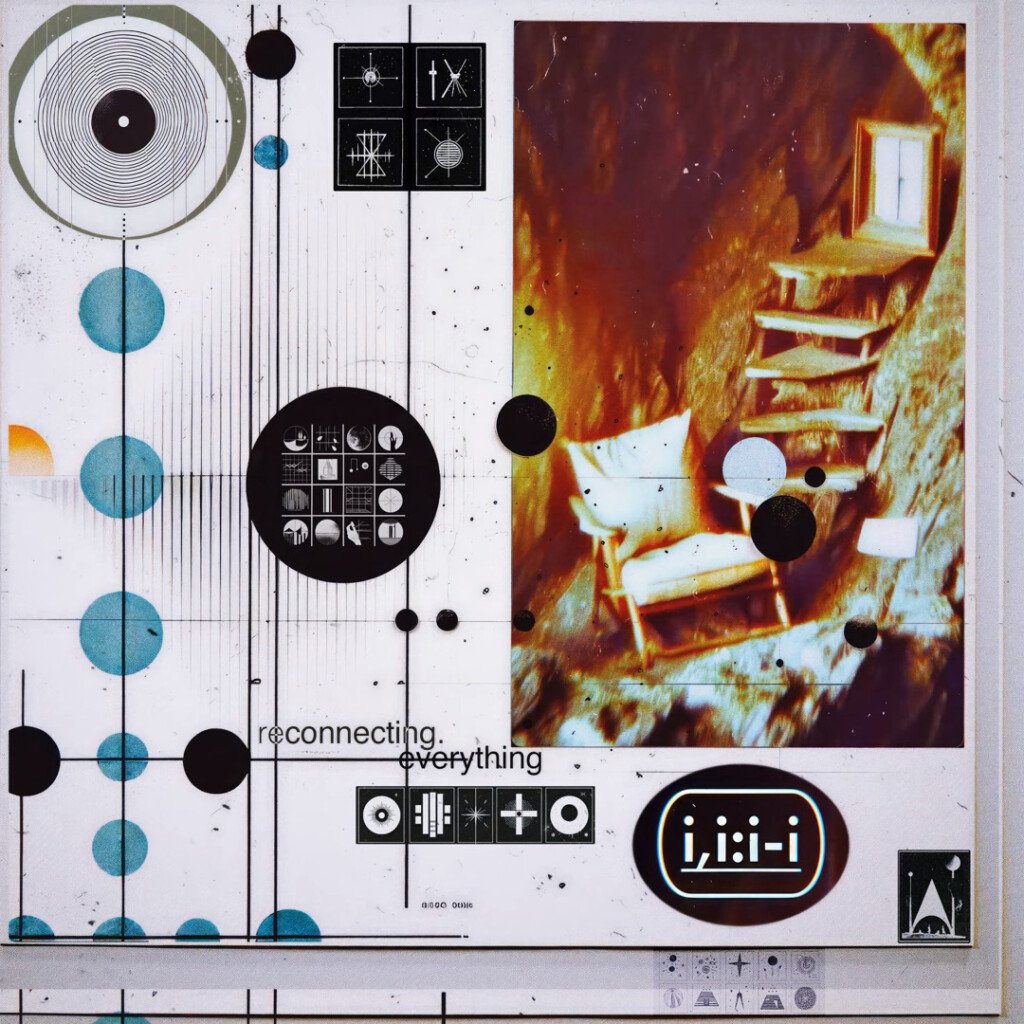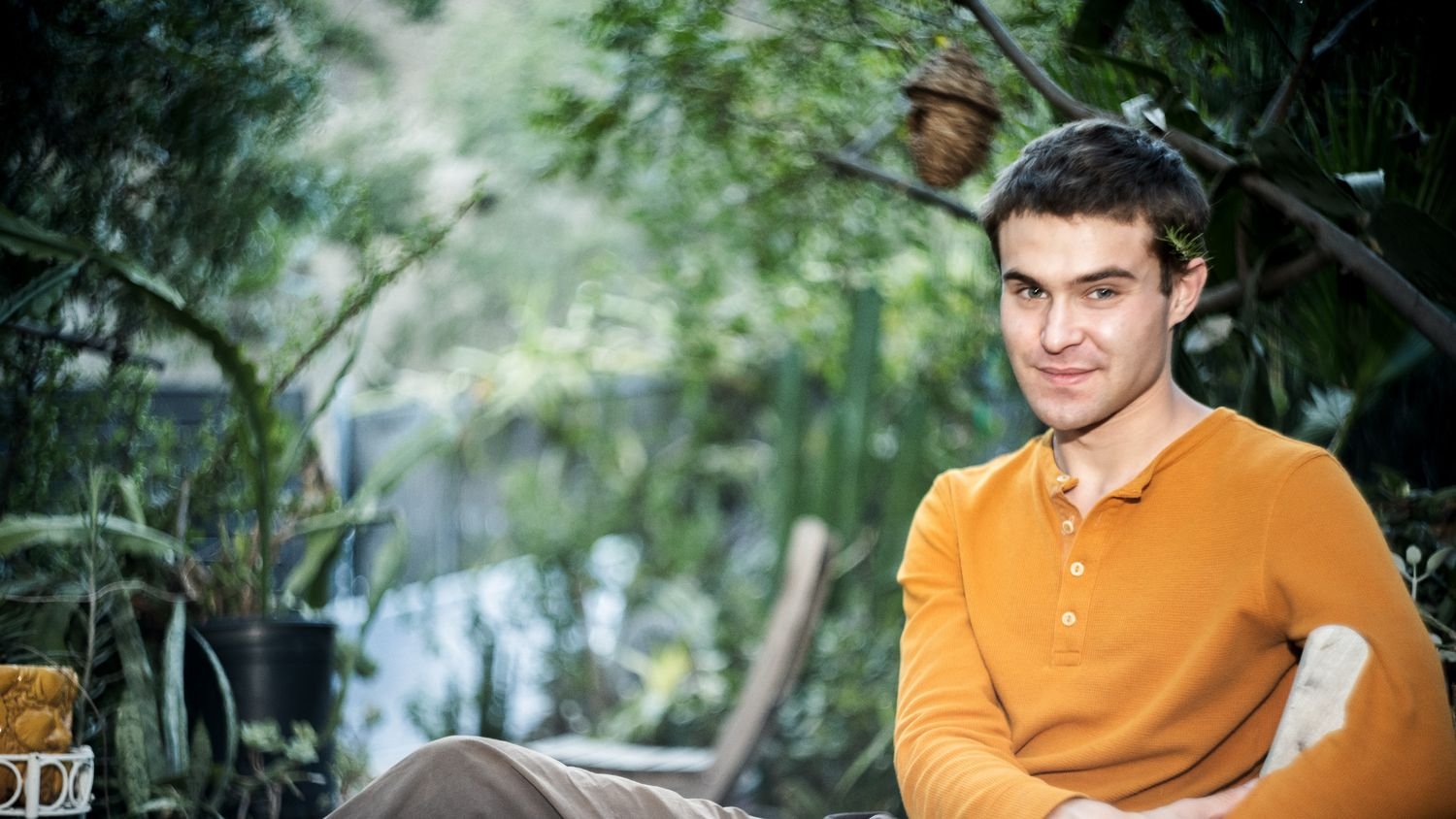
August kamp is a girl in an ever-intensifying game of leapfrog with the systems available on a computer. She taught herself music this way, and through relentlessly supportive co-mentorship with close collaborators and friends over the last five or so years. These days, her art permeates most modalities of media equally – from extensively curated still-image visuals to audio-reactive abstract wordless meditation-videos made near-exclusively for close friends. Even many images and videos recorded from her dreams using “verbal dream-reconstruction imaging”. She follows her curiosity, mostly. She is waist-deep in ai work right now – helping various research-labs tune and perfect artificial intelligence systems that enable her, or anyone, to create whatever is in their head. These systems have opened her mind to a broader perspective on art as a whole, she says: “it’s all just research. You go exploring and you commit to loving and affirming and studying no matter what you come across. Picking your favorites. Because that matters. These stages of silly images and videos that are occasionally incoherent, often identifiable as synthetic in comical ways – these are short days. I’m savoring it. I love the jank. These things are cameras into my dreams, every picture on the cover would have been impossible without these systems. Everyone deserves to be able to share the creativity and love that is already in their head.” Check out the exclusive interview below:
1. Your roots can often shape your journey. Can you share a story or moment from your early life that had a significant impact on your path into music?
AUGUST KAMP: i came up through acting. i took an interest in it when i was around two, and it became my first real relationship to art – performance, storytelling, inhabiting other worlds. it didn’t occur to me until much later, in my late teens after my show on disney channel ended, that the worlds i was stepping into, while meaningful to be a part of, ultimately belonged to other people.
around that time, my own opinions and inner world were solidifying into something more tangible, and that gradually started to feel incompatible with acting. there was a growing desire for ownership over what the story actually was. i had written a lot of songs and lyrics during the later seasons of my show, but i kept the music itself at arm’s length for a while, looking for producers or collaborators to build the sound worlds i was imagining. in hindsight, that feels like i was outsourcing a very important part of the process.
when i fully stepped into making, producing, mixing, and mastering the music myself, something clicked. a sense of identity emerged from being involved in every step, and that became the first step towards seeing myself not just as a participant in creative processes, but as someone who could carry them end to end.
2. Did your musical journey begin with formal training, or was it more of a personal exploration? How has that shaped your unique approach to your craft?
AUGUST KAMP: it was entirely personal exploration. i don’t have a formal music background, and i’ve always had a bit of an allergic reaction to formal training in general. that’s not a universal truth by any means, but for me, early tutorials and instruction-heavy approaches immediately felt like manuals for someone else’s process, applied to tools that could be used in countless ways.
pretty early on, that pushed me toward a more organism-based relationship with software and hardware. i don’t enjoy bossing tools around any more than i enjoy bossing people around, or being bossed around myself. the way i work is much more collaborative, and ideally omni-directional. as i was learning, the artifacts of that experimentation became the defining features of the music itself.
a lot of my work is really a documentation of learning, and that’s something you can sustain for a long time without burning out. albums are much more enjoyable to me when they are the byproduct of a learning process, which is itself almost autonomous within me – making an album is never the goal. It’s just something I start to realize I’ve ended up doing again and again. ultimately i find that much more generative than trying to repeat some agreed-upon “right” way of making things. there were definitely people who offered inspiration or little treasure maps along the way, but i never felt drawn to doing things *correctly* per se. if anything, some of the biggest breakthroughs came from deliberately breaking whatever process i had just started to get comfortable with.
3. Who were some of the most influential figures in your early musical life, and how did they inspire your sound? Also, what’s the story behind choosing the name ‘AUGUST KAMP’?
AUGUST KAMP: there were artists i loved growing up, but none of them really took root in me until just a year or two before i started making music myself. the album “22, A Million” by bon iver was the first record i ever listened to straight through as an album, and it still feels like such an impossibly perfectly preserved artifact from a completely different world. i actually listened to it just today – as in – the day i am answering these questions, and it still feels absolutely eternal to me.
looking back, i can trace the earliest seeds of my unifying outlook on technology and nature to that one record – the sound, the textures, the visuals (that cover), just the emotional language of it. bon iver has been deeply influential to me throughout my music-making life, but “22, A Million” was the album that woke me up. after that, there was no returning to a version of the world where i wasn’t making music.
as for the name, august kamp is my given name. i went by my nickname (gus – which feels strange to type these days) for most of my early life, including my acting years, but when i started releasing music i chose to use august. this was a year or so before i fully stepped into it personally – and a couple years after that, i came out as trans. the name ended up fitting in a way i’m deeply grateful for – it feels like claiming the full version of myself, rather than a shorthand.
4. What do you believe sets your music apart? How would you describe your sound to someone discovering you for the first time, and what emotions or experiences do you hope to evoke in your listeners?
AUGUST KAMP: this question is always a little tricky for me, because what sets my music apart overlaps pretty directly with what sets me apart as a person. over time, and over many conversations, i’ve learned that the way i think – the way i connect pragmatism with hope and a curiosity about systems – isn’t something people seem to encounter very often. i used to take that for granted, but now i’m comfortable seeing it as one of the core things that genuinely shapes my work.
my music comes from a belief that systems are natural, that nature itself is systems, and that the relationships between those systems are worth honoring and paying attention to. that shows up in how i move between acoustic, electric, and electronic sounds without really treating them as separate categories. i don’t like leaning on labels or structures that exist outside of me if i can help it. i’m much more interested in following a fresh curiosity, sometimes through a novel experimental container in the sound palette, and seeing what emerges.
the experience i hope listeners have is something like discovering a truth together. not because i’ve handed them a familiar symbol or a shortcut, but because we’ve arrived at something slowly, through experimentation from first principles. i like the idea that even the newest tools can uncover very old things – that something ancient and real can be found inside methods that feel unfamiliar or modern. if my music does anything, i hope it makes space for that kind of shared recognition.
5. For most artists, originality is first preceded by a phase of learning and, often, emulating others. What was this like for you? How would you describe your own development as an artist and music maker, and the transition towards your own style, which is known as INDIE?
AUGUST KAMP: i spent a lot of my early years making music through what i jokingly called “song-steal.” i would start by very openly trying to emulate a specific idea from a specific song, and almost immediately the result would drift somewhere else. what stuck wasn’t the surface of the song, but the principle underneath it – a chord movement, a pacing choice, a mixing decision.
over time, that turned into a kind of Lego-style process. i’d take the chords from one song, the rhythmic feel from another, maybe a vocal treatment from something a friend had just shown me, and deliberately see if they could coexist. a lot of the work that ended up on reconnecting.everything came out of those experiments – smashing together ideas that didn’t obviously belong together and watching what happened.
it started to feel less like imitation and more like ecology. introducing different creative agents into a shared environment and seeing which ones take root, which ones transform each other, and which ones quietly fall away. that approach taught me a lot about the music i loved, but it also taught me about myself and how i work.
even now, i’ll hear a song and say something like “this is going on my next album,” and what i mean is that there’s something in its DNA i want to understand. not to copy it, but to let it join the small ecosystem of ideas and instincts i draw from when i’m making my own work.
6. Music often transcends entertainment. What’s your view on the role and function of music as political, cultural, spiritual, and/or social vehicles – and do you try and affront any of these themes in your work, or are you purely interested in music as an expression of technical artistry, personal narrative, and entertainment?
AUGUST KAMP: for me, music always starts as a kind of technical ecology. i’m experimenting with systems, tools, and interactions, and seeing what begins to take shape. but very quickly, it becomes emotional. i’m interested in how something feels as it emerges, and that feeling is inseparable from the world it comes from.
i don’t really see political, social, spiritual, or cultural themes as separate lanes. we live inside those structures, and they’re what shape our emotional reality. even something as intimate as a love song exists inside a wider context of power, belief, environment, and history. pretending otherwise can feel like treating symptoms instead of looking at the deeper causes.
the strongest technical moments in my work usually arrive when the emotional pull is honest and fully excavated. that requires paying attention to what i’m processing about the world at that moment, and letting the music and lyrics uncover it together. reconnecting.everything is very much an exploration of that – a lot of this record is a thinly veiled metaphor for the newly occurring advent of ai – a meditation on the group organism, and how humanity responds to the emergence of thinking machines. some people meet that moment with curiosity, others with fear or refusal, and i think there’s something deeply revealing and potentially healing in sitting with that difference.
so i don’t approach music as a vehicle for messaging so much as a space for observation. if the work holds anything political or spiritual, it’s because those things are already present in the emotional landscape we’re all moving through.
7. Do you feel the rewards of your musical career match the energy and passion you invest in it, or are there different kinds of fulfillment you’re still seeking?
AUGUST KAMP: my relationship to that question has changed a lot over time. earlier on, especially coming off acting and starting music, i definitely carried a quiet hope for a very conventional kind of success – recognition, momentum, the sense of “making it.” i didn’t always lead with that, but it was there.
more recently, i’ve found myself in a very different place. i’m realizing that the kind of large-scale visibility we tend to equate with success doesn’t actually feel that appealing to me anymore.
It can easily become a distraction from the work itself, and sometimes even a force that distorts people’s relationship to their own creativity.
what feels genuinely rewarding now is much more self-sustaining. i love reaching people who really want to be there, who find something meaningful in the work and take it into their own lives. the idea of pushing music outward through a big apparatus, toward people who might not be looking for it, doesn’t interest me much at all these days.
i feel like i’ve arrived at a steady orbit that works for me – creatively, emotionally, spiritually. i don’t want very much about that to change. letting the work grow naturally, at its own pace, feels far more fulfilling than chasing a version of success that would disrupt the life i’ve built.
8. Can you walk us through your creative process? From the first spark of an idea to the finished track, what’s the most essential part of your process, and how do collaboration or external influences shape your work?
AUGUST KAMP: my process is pretty amorphous, and it changes from track to track. each song feels like a new area of study, so there isn’t a single path from spark to finish that always applies. what usually comes first is something like a treasure map – a distillation of what i’m taking in at the time, whether that’s internal feelings, music i’m encountering, or a mix of both.
when things get stuck, collaboration can be really helpful, especially with people i trust to push gently and respectfully. my friend and collaborator My Friend Diego is a great example of that. he’s an endless source of new ideas, but never forceful about them, and sometimes just sharing something with him is enough to get it moving again.
ultimately, the most essential part of my process is getting out of the way of the song and letting it become what it wants to become through me. everything else i’ve learned technically is really just a set of tools for nudging that along when it needs it, and knowing when it doesn’t.
9. With social media having a heavy impact on our lives and the music business in general, how do you handle criticism, haters, and/or naysayers in general? Is it something you pay attention to, or simply ignore?
AUGUST KAMP: my relationship to criticism has changed a lot over time. recently, i’ve felt a meaningful shift where the lifelong impulse to prove myself, or to be understood by everyone, has finally loosened its grip. what’s been most gratifying about that is realizing i don’t feel particularly beholden to either criticism or praise anymore.
i’ve come to see other people’s reactions as belonging to them. not in a dismissive way, but in a healthy boundary-setting way. i understand myself, and i feel at peace in that understanding, so the idea of being misunderstood doesn’t feel as threatening as it once did. it doesn’t feel like my responsibility to manage other people’s growth or perception of me, and trying to do so would actually feel intrusive.
that perspective has grown alongside other parts of my life, especially around identity and technology. i’ve learned that fighting every battle, or trying to bring everyone along at the same pace, isn’t actually nourishing. people will come around in their own time, or they won’t, and either way i can still wish them well without taking it on as my work.
as for online criticism specifically, i’ve learned to hold it lightly. i think sincerity is much easier to feel when it comes from real connection, and both meaningful critique and meaningful praise tend to land best when they come from people who genuinely know and care about you. these days, i’m much more interested in staying regulated, present, and open to learning than in reacting to noise, and that’s brought me a lot of peace.
10. Creative work in a studio or home environment, or interaction with a live audience? Which of these two options excites you most, and why?
AUGUST KAMP: i would love to continue developing a relationship with live performance over time, but my honest answer right now is a wholehearted endorsement of the studio and home environment. the space i live and work in now is the most nourishing thing i’ve ever built for myself, and i built it very intentionally.
for a long time, my life felt temporary – moving between rentals, relationships, and situations that never quite allowed me to settle. that made it hard to take ownership of permanence as an idea. living where i do now, at the garden, and shaping a space that i can grow inside of has changed everything. it’s where my best artistic work comes from, and it’s also where i feel the clearest and most grounded in my decision-making.
curating a total environment gives me a deep sense of freedom. the music becomes a reflection of how i exist in that space – my relationship to the land, the climate, the room, the machines on my desk. having ownership over those elements makes me feel more myself than anything else ever has.
as much as i appreciate what live performance can offer, it’s inherently more about other people’s perception, and that doesn’t nourish me in the same way. the studio feels like a sturdy core. when a song emerges from that place, i usually know in advance that it’s true. that certainty is incredibly valuable to me, so if i have to choose, i choose the studio.

STAY IN TOUCH:
INSTAGRAM | X | SPOTIFY | YOUTUBE