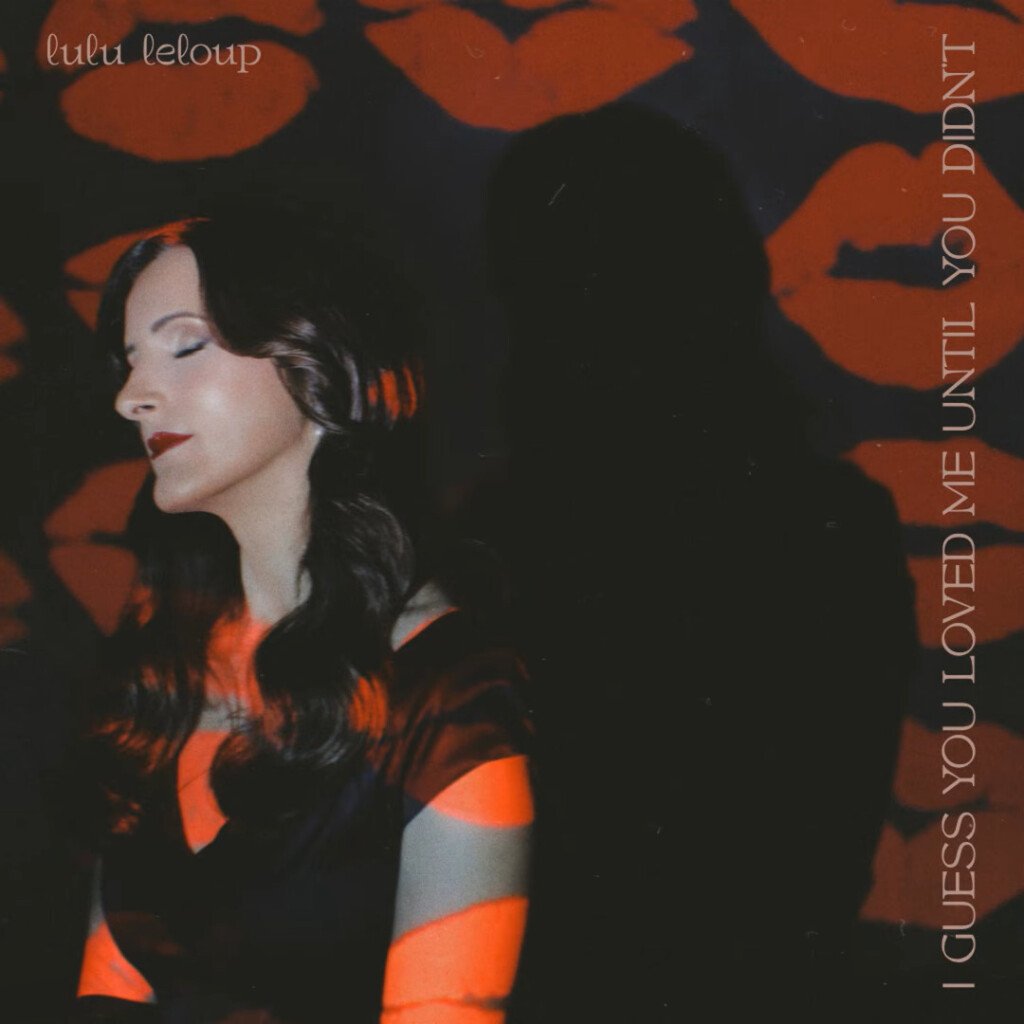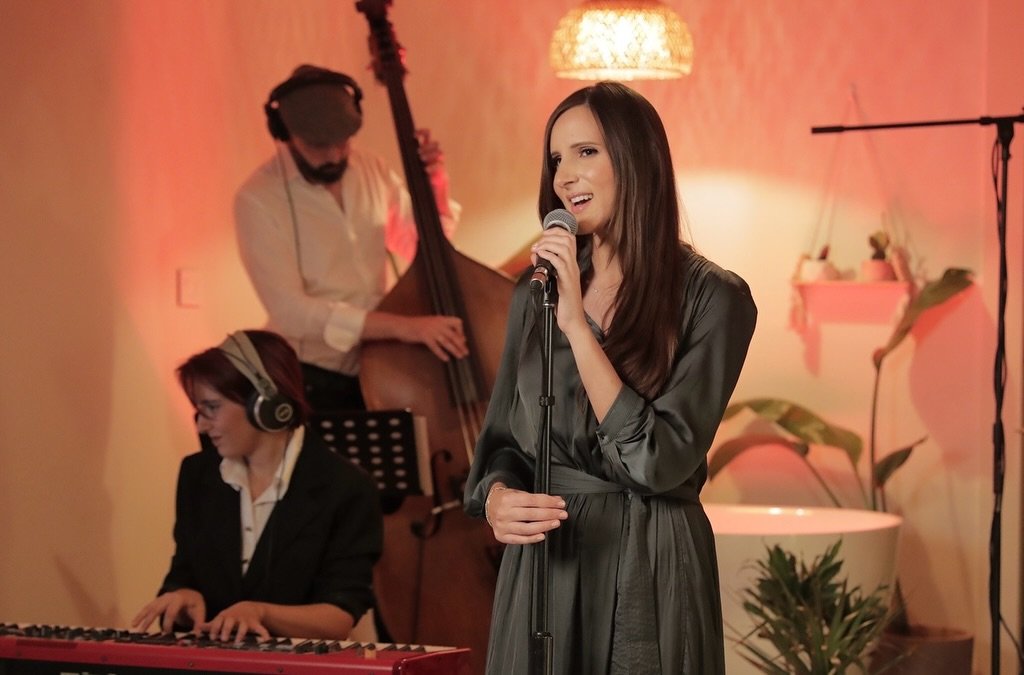
Dubbed “jazz’s darkly comic romantic,” Lulu Leloup is known for a signature sound rooted in vintage charm and clever, modern-day storytelling. Her music nods to the days when Porter and Gershwin spun on the record player, yet her voice is unmistakably hers—clever, intimate, and steeped with a nostalgia that feels freshly written.
Originally from Beirut and raised in Montreal, Lulu is now shaping her story in Beirut & Dubai’s dimly lit jazz corners. Her debut single, Hope I Won’t Love You Anyways, offers a wistful introduction to her playful yet poignant world. Follow-ups, including the sly You Called Me Baby, but Baby You Didn’t Call and the aching (If You’re Gonna Break My Heart, Would You Do It After) March, reaffirm a voice defined by vulnerability and character. Lulu is the 2025 recipient of the OGIMA Music Award for Songwriter of the Year. Visit lululeloup.com for more information & to get in touch. Check out the exclusive interview below:
1. Did your musical journey begin with formal training, or was it more of a personal exploration? How has that shaped your unique approach to your craft?
Lulu Leloup: I took voice lessons as a teen and studied at a musical theater academy post-high school, so I did have some formal training. Writing was more personal exploration.
When I started, I didn’t approach it in any kind of structured way. I had some piano basics, so I would dabble and write on instinct—just what sounded good and felt honest. I suppose as a result, the lyrics and storytelling always seemed to be the anchor of most of my songs. I think that’s still the case.
Eventually I started piano lessons and now I have a wider palette to compose with, but the storytelling is still what carries my approach.
2. Who were some of the most influential figures in your early musical life, and how did they inspire your sound? Also, what’s the story behind choosing the name ‘Lulu Leloup’?
Lulu Leloup: I loved musicals when I was younger. My mom used to play me The Sound of Music and my dad, who was working in London, used to take me to West End shows when I’d visit. I eventually asked for singing lessons and naturally gravitated towards some of the great musical and jazz composers like Gershwin & Porter. They planted the seeds for my love of jazz—though many other influences came later.
As for my name, one of my uncles calls me “Lulu Leloup”—a play on my nickname, Lulu. The original plan was to just go by “Lulu,” but there are too many already, so I went with my uncle’s variation.
3. What do you believe sets your music apart? How would you describe your sound to someone discovering you for the first time, and what emotions or experiences do you hope to evoke in your listeners?
Lulu Leloup: There’s definitely an air of nostalgia in my sound. People often tell me, “You took me to another era”—usually the jazz age—which I love hearing, because so much of my inspiration comes from that period.
At the same time, all my songs are originals, bringing a modern energy – it’s kind of now and then, old and new. That duality is what I hope listeners feel.
4. For most artists, originality is first preceded by a phase of learning and, often, emulating others. What was this like for you? How would you describe your own development as an artist and music maker, and the transition towards your own style, which is known as SOUL?
Lulu Leloup: What’s that Picasso quote—”Good artists copy, great artists steal.” I spend countless hours studying what musicians I love are doing, whether on the piano or through their vocals. I think there’s a lot of value in studying and mimicking musicians you admire.
But then when it comes to my music, I just let that all go. When inspiration hits, I don’t overthink it. I have plenty of songs that I’ve written, but the ones I choose to share are always ones that I wrote genuinely and from the heart. They tend to flow very naturally in the writing process, almost like I just need to follow the music’s lead rather than direct it. That’s when I know I’ve got something that’s a keeper, and truly mine.
5. Music often transcends entertainment. What’s your view on the role and function of music as political, cultural, spiritual, and/or social vehicles – and do you try and affront any of these themes in your work, or are you purely interested in music as an expression of technical artistry, personal narrative, and entertainment?
Lulu Leloup: Music—and art in general—is a reflection of the human experience, and so fundamentally, it’s all of those things. Sometimes it’s more explicit, but it’s always woven into the fabric. Sometimes, simply playing is a stance. Many jazz musicians are examples of that.
In the words of the great Nina Simone, “an artist’s duty is to reflect the times”. I’m happy to report for duty.
6. Can you walk us through your creative process? From the first spark of an idea to the finished track, what’s the most essential part of your process, and how do collaboration or external influences shape your work?
Lulu Leloup: It’s funny ‘cause it’s different every time. Sometimes it starts with a lyric, sometimes a melody, sometimes a chord progression. Sometimes I’ll read or hear something that sparks an idea. Sometimes I write a song in 15 mins, other times, an idea might sit for a year and then suddenly come together. You can’t really force something good out, it only comes when the time is right.
Once the composition is set, then it’s about working with the musicians to bring the arrangement together, balancing guidance with giving them space to improvise. This is where everything starts to really come to life – and it’s magical.
7. Creative work in a studio or home environment, or interaction with a live audience? Which of these two options excites you most, and why?
Lulu Leloup: In the studio, at home, there’s more freedom to explore and try different things – many of which won’t sound good, but that’s just part of the process.
And audiences are a big part of bringing music to life. They inspire new ideas and interpretations. Sometimes they even surprise you with what resonates most with them. That might even take you back to the studio–songs can keep evolving forever.
So both—they serve different, yet very complementary purposes in the creative process.
8. Do you think is it important for fans of your music to understand the real story and message driving each of your songs, or do you think everyone should be free to interpret your songs in their own personal way?
Lulu Leloup: Free to interpret. It’s nice to know a writer’s story—I like to—but the songs that truly stay with people are the ones they can relate to in their own lives.
One of my goals as a musician, is to one day see people singing along to songs I wrote, knowing that they’re singing through the lens of their own experience, not mine. That’s when you know you’ve really connected.
9. With social media having a heavy impact on our lives and the music business in general, how do you handle criticism, haters, and/or naysayers in general? Is it something you pay attention to, or simply ignore?
Lulu Leloup: Not long ago I was talking with one of my piano teachers, Faith, about a video I was hesitant to post because I didn’t think it was “good enough.”
He told me, “You have people who genuinely love what you’re doing and support you. Why focus on the ones who might not? That’s not very fair to us.”
That really stuck with me. Not everyone will love what you do as an artist—that’s normal. But I try my best keep to my energy directed toward the people that do. It’s only fair.
10. What moment or achievement in your career so far has made you feel the proudest, and why? And let’s talk about your latest release and future plans.
Lulu Leloup: Releasing my first single, “Hope I Won’t Love You Anyways,” and seeing the reaction was a very proud moment. Sharing my music had been years in the making, and I wasn’t doing it for anyone else—just for the love of it—and it felt amazing to see it resonate with people.
Next up is my debut EP, March, coming out on the 27th. It has six tracks that explore love, heartbreak, and things I almost left behind. The songs are very personal, but I think they tell universal stories, and I’m really excited to share them.

STAY IN TOUCH:
INSTAGRAM | SPOTIFY | WEBSITE | YOUTUBE