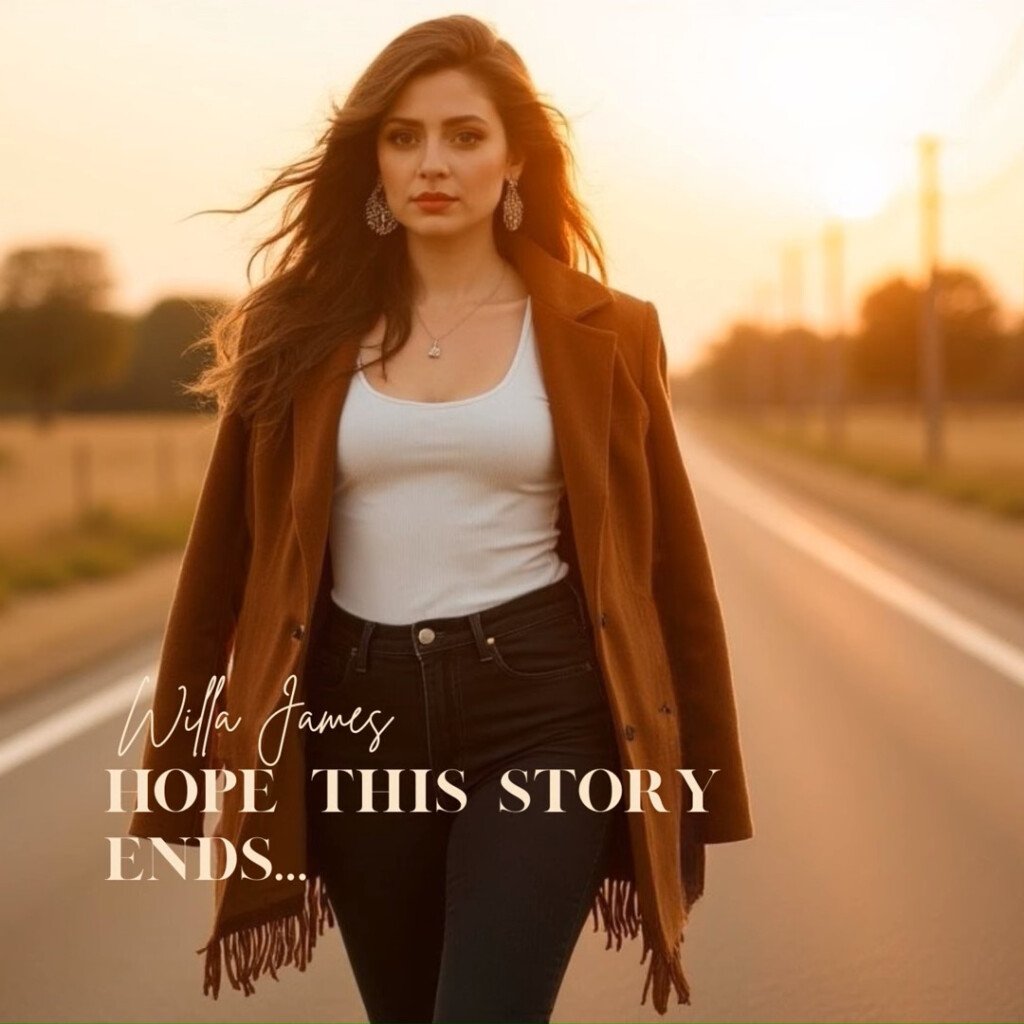
Willa James is a country-blues singer bringing real stories to life. Blending soulful grit with modern tools, Willa delivers raw storytelling shaped by real lived human experience. Whether she’s singing about time catching up or trust running dry, Willa James sounds like the friend who tells you the truth, pours you another drink, and still believes you’re worth a second chance. Check out the exclusive Interview below:

1. Your roots can often shape your journey. Can you share a story or moment from your early life that had a significant impact on your path into music?
Willa James: Music was always around when I was growing up, but I didn’t see it as something meant for me at first. It showed up in small, ordinary ways songs playing in the kitchen, long car rides with the radio on, quiet moments where feelings didn’t have anywhere obvious to land. I remember realizing pretty early on that a song could say things I didn’t know how to say out loud. It felt safer to feel things through music than to explain them. That’s where it really started for me not chasing a stage or an audience, but finding a place where honesty could exist without pressure. That relationship with music has stayed with me ever since and still shapes how I write today.
2. Did your musical journey begin with formal training, or was it more of a personal exploration? How has that shaped your unique approach to your craft?
Willa James: It was much more personal exploration than formal training. I didn’t grow up with structured lessons or a clear path into music, so I learned by listening, feeling, and paying attention to what moved me. That freedom shaped how I write, I’m less concerned with doing things “the right way” and more focused on whether something feels true. I trust instinct over perfection, emotion over technique. In a way, not being formally trained gave me permission to stay curious and vulnerable, and that’s become a big part of my sound.
3. Who were some of the most influential figures in your early musical life, and how did they inspire your sound? Also, what’s the story behind choosing the name ‘Willa James’?
Willa James: Early on, I was drawn to artists who felt more like storytellers than performers. People like Lucinda Williams, Bonnie Raitt, and Patty Griffin showed me that imperfection could be powerful and that emotion mattered more than polish. I also leaned heavily into blues artists like Tab Benoit because that genre doesn’t flinch from pain or complexity. Those influences shaped my sound into something rooted, honest, and a little raw, where the song always comes first.
As for the name Willa James, I wanted something that felt timeless and grounded like it could belong to anyone, anywhere. Willa felt soft but strong, and James felt classic and steady. Together, the name gave me a place to tell stories freely, without needing to explain myself or fit into a specific box.
4. What do you believe sets your music apart? How would you describe your sound to someone discovering you for the first time, and what emotions or experiences do you hope to evoke in your listeners?
Willa James: My sound sits at the intersection of blues and Americana country. The earlier songs lean more into blues, raw, sparse, and shaped by pain, trust, and emotional weight. As the writing has evolved and healing has started to take root, the sound has shifted with it. There’s more Americana now warmer melodies, a little more light, and a sense of forward motion.
What ties it all together is storytelling. Every song is grounded in real experience, whether it’s sitting in the ache of something breaking or finding steadier ground on the other side of it. I hope listeners hear their own journey reflected in that progression and feel permission to be wherever they are hurting, healing, or somewhere in between.
5. For most artists, originality is first preceded by a phase of learning and, often, emulating others. What was this like for you? How would you describe your own development as an artist and music maker, and the transition towards your own style, which is known as COUNTRY?
Willa James: Like most artists, my early writing was shaped by listening closely to the people who moved me. I wasn’t trying to copy anyone, but I was learning how songs worked how honesty sounded, how restraint could say more than volume, how a story could carry emotion without needing to explain itself. Early on, that showed up in blues-influenced writing because that genre gave me permission to sit with pain and uncertainty without resolving it too quickly.
Over time, something shifted. As the writing moved out of survival mode and into reflection and healing, the sound followed. The songs became more melodic, more grounded, and more rooted in Americana and country storytelling music that still carries weight, but also movement and hope. That transition wasn’t strategic; it was emotional. The style changed because I changed.
6. Music often transcends entertainment. What’s your view on the role and function of music as political, cultural, spiritual, and/or social vehicles – and do you try and affront any of these themes in your work, or are you purely interested in music as an expression of technical artistry, personal narrative, and entertainment?
Willa James: I believe music naturally carries cultural, emotional, and even social weight, whether the artist intends it to or not. Songs reflect the moment they’re written in the values, fears, and questions people are living with so in that sense, music is always participating in something larger than entertainment. That said, I don’t approach songwriting with the goal of making political or ideological statements.
My work comes from personal narrative first. I’m interested in telling honest human stories about trust, loss, repair, and resilience because those experiences are universal. If a listener finds cultural, spiritual, or social meaning in the songs, I welcome that, but I don’t try to prescribe it. I’d rather leave space for people to bring their own lives into the music than tell them what they should feel or believe.
Sometimes simply naming a feeling, or sitting with it long enough to be understood, is its own quiet form of impact.
7. Do you think is it important for fans of your music to understand the real story and message driving each of your songs, or do you think everyone should be free to interpret your songs in their own personal way?
Willa James: I think the real story behind a song matters in the sense that it gives the writing its honesty and integrity, but I don’t believe listeners need to know my exact story for the music to work. Once a song is out in the world,
It belongs to the person hearing it as much as it belongs to me. I write from real experiences because that’s what makes the songs truthful, not because I need the details to be understood or agreed with. If someone connects to a song in a way that’s different from what inspired it, that doesn’t feel like a loss to me, it feels like the song has done its job.
Music, at its best, creates room for people to see themselves in it. I’m less interested in being fully explained and more interested in being felt.
8. Can you walk us through your creative process? From the first spark of an idea to the finished track, what’s the most essential part of your process, and how do collaboration or external influences shape your work?
Willa James: Most of my songs start quietly, with a line, a feeling, or a moment that won’t let go. It’s usually something unresolved: a thought I keep circling, an emotion that doesn’t have a clean ending yet. I don’t force it into a song right away. I let it sit until the language feels honest instead of clever.
The most essential part of my process is staying truthful to that initial feeling and not polishing it into something unrecognizable. Collaboration and external tools come in after the writing is solid. I use technology, including AI, to give the songs a voice and shape, but it doesn’t drive the creative decisions. The heart of the work happens before that, alone, in the writing. Outside influences help with perspective and execution, but the direction always comes from the story the song is trying to tell.
9. What’s been the most challenging hurdle in either your personal life or music career, and how has it shaped you as an artist?
Willa James: The most challenging hurdle for me has been finding my way back to music honestly after a long period of silence. There was a time when life, responsibility, and self-doubt slowly pushed creativity to the margins, and returning to it meant confronting a lot of fear about whether my voice still mattered, whether the stories were worth telling, and whether it was too late to begin again.
That experience reshaped me as an artist. It taught me to value truth over performance and intention over approval. Instead of chasing what music is supposed to look like, I focused on what it needed to say. The songs that came out of that process are more grounded, more patient, and more emotionally precise than anything I would’ve written earlier. In many ways, the obstacle clarified the work. It stripped away ego and left only what was essential.
I learned that there’s more than one way to bring a song into the world, and what matters most is staying faithful to the story it carries.
10. On the flip side, what moment or achievement in your career so far has made you feel the proudest, and why? And let’s talk about your latest release and future plans.
Willa James: The moment I’m most proud of so far isn’t tied to a single milestone or metric. it’s the act of releasing the music at all. For a long time, these songs lived quietly, unfinished or unheard, and choosing to let them exist publicly felt like a real threshold. It meant trusting the work enough to stop protecting it. Letting that happen required a level of trust, in the writing and in myself that I hadn’t had before.
The album’s anchor is Hope This Story Ends…, a title that’s intentionally misleading. At first glance, it sounds like giving up, but if you listen closely, it can mean two very different things: hoping something finally ends, or hoping it doesn’t. That tension lives inside a lot of relationships, and most of us have felt both sides of it at the same time. The song holds that ambiguity without resolving it, and in many ways, the album grows outward from there.
Looking ahead, my plans are to keep building on that emotional arc, continuing to release music that follows the movement from fracture toward repair, with storytelling at the center. I’m focused on depth and continuity, not quick moments, and letting the work unfold honestly over time
11. With social media having a heavy impact on our lives and the music business in general, how do you handle criticism, haters, and/or naysayers in general? Is it something you pay attention to, or simply ignore?
Willa James: I pay attention in the sense that I stay aware, but I don’t let it steer the work. Not all feedback is the same. Thoughtful criticism can be useful, especially when it comes from a place of care or curiosity. But noise for the sake of noise isn’t something I engage with. Social media rewards attention, but attention isn’t the goal for me.
I’m not particularly interested in becoming famous. What matters more is knowing the songs land with people who recognize themselves in them. If someone hears a song and feels less alone in something they’ve lived through, that carries far more weight than visibility or approval.
As long as the work stays honest and reaches the people it’s meant for, the rest tends to take care of itself.

STAY IN TOUCH:
FACEBOOK | INSTAGRAM | SPOTIFY | TIKTOK | WEBSITE | YOUTUBE