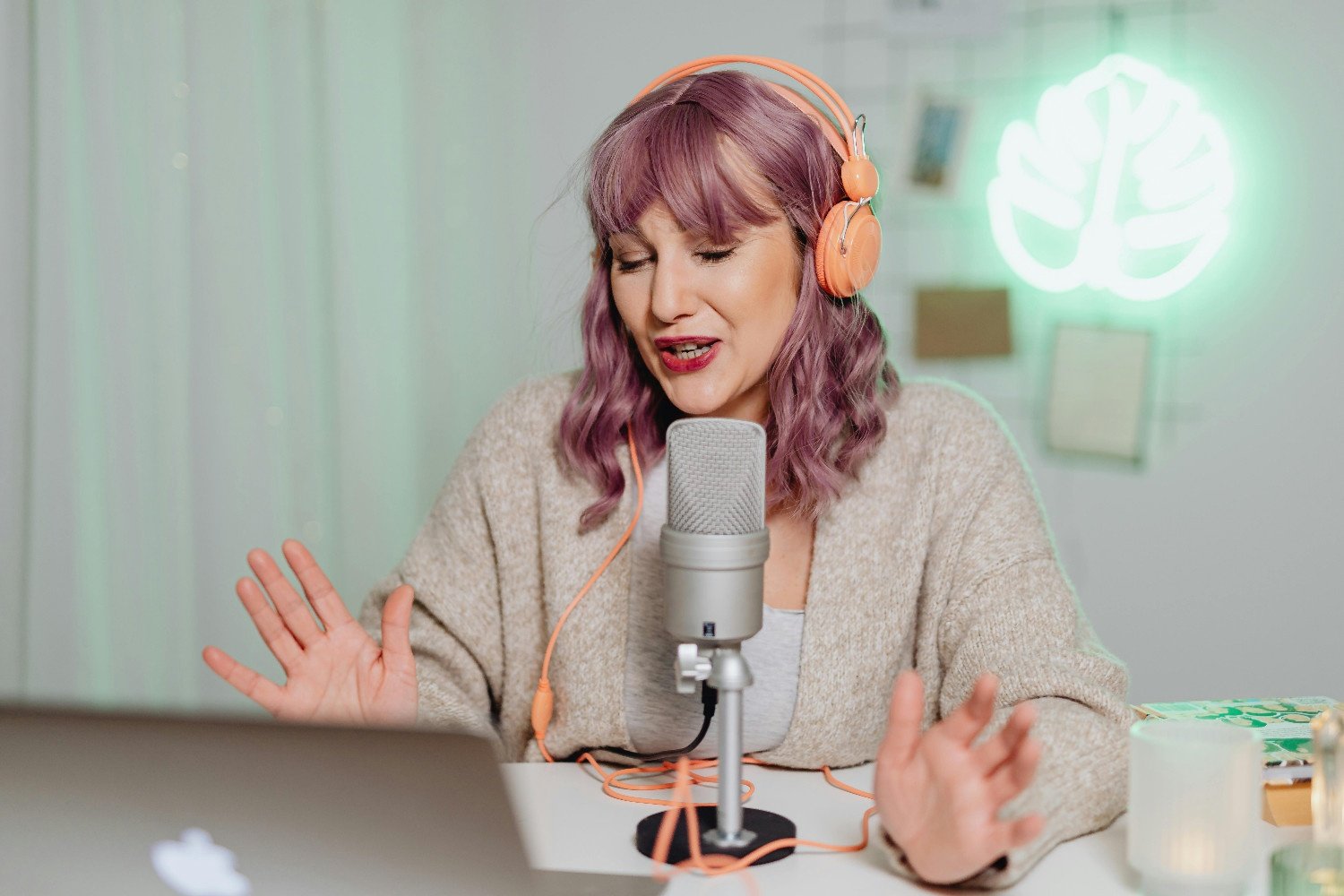
From real-time pitch feedback to AI-generated lesson recaps, the architecture of singing instruction is being quietly rebuilt, and it’s not the future of vocal training that’s changed, it’s the present.
For most of the past century, learning to sing has looked the same: a singer in a room with a coach, a piano, a mirror, and a lot of repetition. The coach listened. The student tried again. Improvement was slow, expensive, and gated by access to the right teacher in the right city.
That model isn’t dying, but it’s no longer the only option. Vocal training in 2026 sits at the intersection of three things that didn’t exist a decade ago in any usable form: machine-learning models that can hear what your voice is actually doing in real time, mobile devices powerful enough to run them, and a generation of singers who grew up expecting feedback loops as fast as their TikTok drafts.
The global online music education market is on track to hit roughly USD 4.61 billion in 2026, growing at around 15% annually, with vocal coaching one of its fastest-rising segments (Mordor Intelligence). What follows isn’t a celebration of “the AI singing coach” – it’s a closer look at the specific places where technology is genuinely changing what vocal training is, and the places it isn’t.
1. Real-Time Pitch Feedback Finally Got Good
Pitch-detection software has been sold to singers since the late 1990s. For most of that history, it was a novelty: laggy, easily fooled by vibrato, and confused by anything outside a clean vowel sustained in a quiet room.
That changed when machine-learning pitch estimators started outperforming the older autocorrelation-based algorithms. Modern systems now deliver real-time pitch feedback at around 91.9% accuracy under realistic conditions, which is close enough to a human ear that singers can trust what the screen is showing them and adjust mid-phrase rather than after the take.
The pedagogical idea isn’t new. As far back as 1989, researchers Graham Welch, David Howard, and Cynthia Rush demonstrated that students who could see their pitch displayed visually while singing improved faster than students working from audio feedback alone. The visual representation acts as scaffolding for what is otherwise an invisible motor skill: it gives the brain a target to map to laryngeal muscle action, and the mapping eventually internalises so the singer no longer needs the screen.
What’s changed is the fidelity. Apps like Vanido, SingTrue, and Erol Singer’s Studio now show not just whether you’re flat or sharp, but how flat, on which syllables, drifting in which direction, and whether you’re hitting the centre of the note or grazing the edge. Some plot a continuous waveform alongside the reference melody so a singer can watch the gap close in real time.
The implication for technique training is concrete. Less than 5% of the population has clinical amusia – actual tone deafness. The remaining 95% who think they “can’t sing” usually have a perfectly functional ear and an untrained connection between that ear and their vocal cords. Real-time visual feedback is, essentially, a way to make that connection visible while the singer builds it.
Practical Tip: If you’re working with a vocal app, run the same scale exercise daily for two weeks and screenshot your accuracy graph at the end of each session. The pattern of where you drift – always sharp on the upper passaggio, always flat on consonant attacks is more useful than any single score.
2. The Analysis Got Smarter Than Just Pitch
Pitch is the easy part. The harder problem in vocal training has always been the things singers describe with metaphors: support, placement, ring, weight, brightness. These map to measurable physical phenomena – formant frequencies, subglottal pressure, vibrato rate and depth, spectral tilt – but until recently those measurements lived in research labs.
Newer vocal tools are starting to pull pieces of that lab into consumer apps. Spectrogram views show singers where their formants are clustering, helping them feel the difference between a “covered” and “open” vowel. Breath-tracking systems, some using just the phone’s microphone and others using small chest-worn sensors, give feedback on phrase planning and breath management. A 2022 study from a multimodal breath-guidance interface found singers improved average pitch accuracy by 21.25% when they could see their breath patterns alongside their pitch in real time.
Convolutional neural networks are now being trained on thousands of labelled vocal performances to evaluate things that used to be entirely subjective. A peer-reviewed 2025 study published in Discover Artificial Intelligence trained a CNN-based model to score student singing across pitch accuracy, rhythm control, vocal skill, and emotional expression, achieving 85.6% validation accuracy against human teacher ratings.
That last category – emotional expression – is the one that should make every vocal teacher slightly nervous and also fascinated. It’s not perfect. But the fact that a model can now distinguish, with reasonable accuracy, between a technically clean cover and one that actually moves you is a real shift.
The practical effect on training is that students can get nuanced feedback between lessons. A traditional vocal student might bring three things to a weekly lesson – a song they’re working on, a question about a technique, a problem area they noticed. A student using AI-assisted practice tools is bringing data: where their vibrato rate slows on sustained notes, which vowels collapse their formant clarity, exactly when in a song their breath support starts to fail.
That doesn’t replace the coach. It changes what the coach gets to do with the hour. Instead of spending half the lesson diagnosing what’s wrong, the coach starts at the diagnosis and spends the whole hour fixing it.
3. The Between-Lesson Gap Is Finally Getting Solved
This is the part of vocal training that has always been the weakest link. A singer takes a lesson on Tuesday. Three days later, they sit down to practice and can’t remember exactly what their coach said about the placement of that high note. Was the chest voice supposed to drop earlier? Or carry up? Was it the consonant that was tense, or the vowel? By Friday, the memory is foggy. By next Tuesday, the bad practice habits are already baked in.
This problem is older than vocal training itself, every motor-skill discipline deals with it. But singing is particularly vulnerable because the corrections are often felt, not articulated, and the body’s memory of “what the right thing sounded like” decays faster than a list of dance steps would.
A growing crop of tools is trying to close that gap by giving learners structured, personalised material to revisit between lessons rather than relying on memory, and Wiingy CoTutor is a strong example of this concept in action. Through this AI-powered learning companion, singers taking 1-on-1 vocal lessons have their sessions transcribed and analyzed by AI to generate a complete set of personalized study modules. This automated system transforms the live lesson into a podcast-style audio summary that the student can listen to on a commute, alongside highlighted key technique notes, custom quizzes generated from the specific things their coach covered, and flashcards for the exact vocabulary, such as pitch, tone, tempo, and breath markings – that came up during their session.
The pattern matters more than the specific product. The point is that the lesson stops being a one-off event and becomes a piece of content the student can revisit, sliced into the formats that actually fit how people learn outside the classroom. Wiingy reports the modules drive roughly 4.8x higher engagement than traditional lesson recordings and around 85% retention, with students spending about 10 minutes on a CoTutor module versus an hour and a half on the equivalent raw recording.
For vocal students specifically – where what was said in the lesson can quickly become disconnected from how the body is supposed to reproduce it – having a 10-minute audio podcast of “what we worked on, what to focus on this week, why your soft palate kept dropping on the bridge” available on demand is a meaningfully different thing from a forgotten Zoom recording.
Practical Tip: Treat the post-lesson AI summary as part of the lesson, not as homework. Listen to it within 24 hours, while the muscle memory is still warm. That’s where the consolidation actually happens.
4. Genre-Specific Coaching, Without the Gatekeepers
For most of the past century, a vocal student’s genre depended on who their teacher was. A classically trained coach in a conservatory town wasn’t going to teach you to belt like Ariana Grande, scream like a hardcore frontman, or growl like a death-metal vocalist. A pop-leaning coach in Nashville wasn’t the right person to walk you through the chest-mix transitions of musical theatre. Geographic and stylistic gatekeeping was real, and for singers in smaller cities it was crippling.
Online platforms broke the geography problem first – a singer in Bengaluru could now book a 1-on-1 with a Berklee-trained coach in Boston. AI-assisted training is now starting to break the stylistic gatekeeping in a different way, by making genre-specific analysis tools genuinely usable. Models trained on heavy-metal screams analyse very differently than models trained on bel canto, and platforms are starting to offer style-specific feedback rather than one universal “is this pitch right” metric.
That matters because the technique requirements diverge sharply between genres. A clean R&B run requires precise pitch placement on rapidly changing notes – exactly the thing real-time AI feedback is best at evaluating. Metal vocal training, conversely, is much more about laryngeal positioning, false-cord control, and avoiding damage, and emerging tools are starting to use audio spectral analysis to flag potentially harmful techniques before it becomes an injury.
The cumulative effect for the singer is one of access. A 16-year-old in a town with one church-choir coach can now get the kind of style-specific guided practice that used to require moving to LA or New York. They still benefit enormously from a human teacher. But they’re not stuck waiting for one to exist in their zip code.
5. One-on-One, at Scale
The other quiet revolution is just plain old video lessons getting cheaper, better, and more available. Industry analysts forecast that live one-on-one music instruction will grow at roughly 16.1% annually through 2031 – faster than the overall music education market, and significantly faster than self-paced courses. Asia-Pacific is leading that surge.
Two things changed to make this work. First, video and audio latency dropped to the point where a coach in London can hear a singer in Manila’s onset attack clearly enough to correct it in real time. Second, AI-driven scheduling, matching, and lesson-augmentation tools (transcripts, summaries, asynchronous module generation) have made the cost-to-quality ratio of remote lessons close to in-person – sometimes better, because the recordings, transcripts, and AI-generated review materials are baked in.
For a vocal student in particular, this is consequential. Vocal coaching has always been one of the most coach-dependent disciplines in music. You can teach yourself a lot of guitar from YouTube before you need a human. Singing is harder to self-teach, partly because you can’t hear yourself accurately from inside your own head, the bone-conducted version is misleading – and partly because correcting technique often requires real-time intervention. The combination of remote 1-on-1 coaching plus AI-augmented between-lesson reinforcement is what’s actually making good vocal training accessible to people who don’t live near a great teacher.
6. The Wearables and Biofeedback Frontier
This is the still-early bit. A handful of companies are working on chest-worn or throat-worn sensors that measure breath flow, subglottal pressure, and laryngeal vibration during practice. The use cases range from preventing vocal injury in working singers – flagging when fatigue starts to show in spectral features before the singer can feel it – to giving teachers a richer data set about what’s happening physically when a student sings.
It’s not consumer-grade yet. Most of the interesting work is happening in voice clinics and university labs, with prosumer-priced devices like the VoceVista Pro suite straddling the line between research tool and singer’s toy. But the trajectory is clear: the same way runners now train with continuous heart-rate, lactate, and stride data, singers within the next few years are likely to be training with continuous breath, larynx-vibration, and formant data.
The risk is obvious – singers becoming so dependent on metrics that they lose the intuitive feel for their own instrument. The opportunity is equally obvious. For the first time, the actual physical machinery of singing is being made visible to the people operating it.
7. What the Algorithms Still Can’t Do
Worth naming bluntly. Independent research on AI-powered karaoke and singing apps has found a real pattern: in one study, 72% of users improved their in-app pitch-match score, but only 31% showed equivalent improvement when singing the same material unaccompanied into a neutral microphone. The apps gamify accuracy, but a chunk of the improvement doesn’t transfer.
This isn’t a reason to abandon the tools. It’s a reason to use them honestly. AI feedback is excellent at the technical pieces – pitch, timing, breath consistency, vibrato rate, and it is genuinely better than most teachers at flagging tiny pitch drifts the human ear smooths over. It is much weaker at three things:
- Interpretation and emotional choice. Whether a phrase should be sung loud or soft, leaned-into or pulled-back, is a musical decision a model can score against existing examples but can’t actually make.
- Diagnosing why technique fails. A model can see that the high A is wobbling. A teacher can see that the wobble is because the singer is tensing their jaw and inhaling shallowly out of fear of the note.
- Building the relationship that makes a vocal student keep showing up. Singing is vulnerable in a way most disciplines aren’t. The teacher’s role as a witness and trust-holder is not something an AI is going to replace.
The best programs in 2026 are not picking sides. They’re using AI tools to handle the technical scaffolding – feedback, between-lesson reinforcement, progress tracking — and freeing human coaches to do the harder, more interesting parts of teaching someone to sing.
The Voice Hasn’t Changed. Everything Around It Has.
What’s actually new about vocal training in 2026 isn’t any single piece of technology. It’s the architecture: a real human coach, working remotely with a student anywhere in the world, supported by AI that handles the bits of teaching that don’t actually need a person – the analysis, the reinforcement, the practice-tracking, the between-lesson study material and amplifies the bits that do.
This is genuinely good news for singers who have spent decades being told they need to live in the right city, find the right teacher, and pay the right hourly rate to make real progress. None of those things have completely stopped being true. But the bar for getting serious training is meaningfully lower than it was even three years ago, and the tools available to a curious 14-year old with a smartphone and decent earbuds are, in some respects, better than what conservatory students had in 2015.
If you’ve spent years assuming serious vocal training wasn’t for you because of where you live or what you can afford, the honest answer in 2026 is: try again. Book a remote lesson with a coach whose work you respect, layer an AI feedback tool over your daily practice, and find a system that gives you back what was said in the lesson when the lesson is over. The voice itself hasn’t changed. Everything around it has.
#This is a Contributor Post. Opinions expressed here are opinions of the Contributor. Illustrate Magazine does not endorse or review brands mentioned; does not and cannot investigate relationships with brands, products, and people mentioned and is up to the Contributor to disclose. Contributors, amongst other accounts and articles may be professional fee-based.#