1. Your roots can often shape your journey. Can you share a story or moment from your early life that had a significant impact on your path into music?
D.D.R.: I grew up in the 1980s, so maybe that gives me an unfair advantage or just a different appreciation for what music can be. The first album I owned was either Michael Jackson’s Thriller or Prince’s Purple Rain. I can’t remember which I had first, but I do remember being smart enough to know not to play “Darling Nikki” loud enough for my parents to hear, so the bar was set pretty high early.
I distinctly remember being around 12 years old when I was at my first school dance and hearing “You Give Love a Bad Name” for the first time. It wasn’t just that all the girls went crazy (although 12-year-old me certainly noted that), but it was the guitars, that gang vocal opening, and driving rhythm that had me hooked immediately. I dove into everything Bon Jovi had released up until then and never really looked back.
That was the true beginning of my love of music: that one moment, that one song that had everyone singing along. Amazing.
2. Did your musical journey begin with formal training, or was it more of a personal exploration? How has that shaped your unique approach to your craft?
D.D.R.: For me, it’s always been more of a personal exploration. I never learned formally how to play an instrument, and a big part of that was that song lyrics were always what I connected with most. I had already developed a knack for writing and a love of what words could do, so coming of age in that era, writing my own lyrics became my own personal therapy for learning about myself and how to express these weird, obnoxious things I was feeling (turns out they were emotions. Who knew?).
All kidding aside, that’s still how I view writing a song. It’s therapy for whatever I am feeling at that moment. Sometimes it’s a sad feeling about heartbreak, but sometimes I just want to have fun and write something silly.
Now, call it age or wisdom, but I’ve come to realize these “emotions” aren’t unique to me, and if other people can identify and connect with what I’m trying to say, I believe there is value there.
3. Who were some of the most influential figures in your early musical life, and how did they inspire your sound? Also, what’s the story behind choosing the name ‘D.D.R.’?
D.D.R.: Bon Jovi was the gateway for me to bands like Def Leppard, Motley Crue, and Poison. Then came Skid Row and Warrant in the late 80s. I really identified with the way Jani Lane wrote lyrics, and I think if there is one artist that is mirrored in the lyrics I write now, it’s probably Jani.
Beyond that, that type of music that I gravitated toward had a specific song structure that I learned as a young kid soaking up knowledge without even realizing it: a strong melodic opening that hooks the listener, then the next section increases the urgency and starts to rev the engine of the song, both with the way the lyrics engage and the music underneath gaining intensity. Then the chorus is the release, the liftoff. That structure, when it has something to say and is done well, is enormously emotionally satisfying.
Then, some songs had bridges, and some did not. I was conscious of that even if I didn’t know why. Sometimes the song needed a bridge to take the next step in the story. Sometimes the guitar solo did the talking. It depended on what best served the song.
That may be one of the lost arts in today’s music. We want quick hits and short songs to feed the algorithm, but sometimes the music needs space to speak. Guitars in the ’80s were almost like the second vocalist. I still like to hear what the guitarists have to say.
I wrote a lot of song lyrics in my teenage years and early 20s, but then that output slowed down a bit when I started working on my novels. I eventually found my way back to songwriting around the same time “Divorced Dad Rock” was becoming an unofficial sub-genre of rock music. Since being a divorced dad was something I was going through myself, it made me chuckle that the label fit both the music I loved and the person making it. So when it came time to name the project, D.D.R. felt appropriate.
It was also not lost on me that using an abbreviation leaves a little ambiguity should I ever choose to claim it stands for something else in the future.
But not Dance, Dance, Revolution. I’ll stay in my lane.
4. What do you believe sets your music apart? How would you describe your sound to someone discovering you for the first time, and what emotions or experiences do you hope to evoke in your listeners?
D.D.R.: I’m a storyteller at heart. I’m not trying to remake music from the 1980s, but I am trying to use the language of rock from that era to tell honest stories with a modern edge. I would describe it as melodic rock meant for an arena-sized communal sing-along experience.
The way I write and my voice may be unique to me, but I consider myself a fairly normal guy. The experiences I’m writing about are easily identifiable. Music, to me, is about connection, so if someone hears one of my songs and sees themselves in it in some way, that is more than enough for me to call it a success.
5. For most artists, originality is first preceded by a phase of learning and, often, emulating others. What was this like for you? How would you describe your own development as an artist and music maker, and the transition towards your own style, which is known as ROCK?
D.D.R.: I may have touched on some of this already, but I was an insatiable learner as a kid. When I had interests, I delved into them to an alarming degree. I could cite not just the entire 25-man roster of the Cubs back then, but the rest of National League teams as well. (But not the American League. Amateur hour. LOL). Music was the same way. I just kept listening and learning.
Fast-forward to today and the collaborations I have had with Musiversal musicians, and the identity becomes even more clear when I have to communicate the sound I’m going for with professional artists. Having to explain what I hear in my head forces me to understand it better myself.
And I’m always trying to learn from them as well. I may know that I like the sound of something, but a lot of times they can articulate why I like it, and that is invaluable to me moving forward. It’s almost like a crash course in music theory for a guy who mostly just writes by instinct.
In a strange way, I’m learning the technical vocabulary for a musical language I’ve been speaking for most of my life.
6. Music often transcends entertainment. What’s your view on the role and function of music as political, cultural, spiritual, and/or social vehicles – and do you try and affront any of these themes in your work, or are you purely interested in music as an expression of technical artistry, personal narrative, and entertainment?
D.D.R.: The beauty of music, and entertainment in general, is that it can be all of those things, but each individual artist gets to choose what they want to say today.
I’m not an overly political person, but I have written a song or two that skews that way. I have opinions and views that I will sprinkle into my work from time to time. The important thing for me is recognizing that my views and opinions are my own. They don’t have to be shared by anyone else. A lot of time I know they won’t be, and occasionally I’ll share one anyway just to get an eyeroll or a chuckle, preferably both.
What I never want to do is come across like I’m preaching or telling someone how things are or how they should be. I’d rather just speak honestly about my own experiences and leave enough space for people to find themselves in the music in their own way.
7. Do you feel the rewards of your musical career match the energy and passion you invest in it, or are there different kinds of fulfillment you’re still seeking?
D.D.R.: Wait, there are rewards? I’m kidding. Honestly, I’m having a blast. Just writing something and being able to see that it communicates what I was trying to say, and hearing it sound the way I envisioned it in my head, is the ultimate reward. Any measure of success on top of that is just icing on the cake. I’m just a writer telling stories that I hope people can enjoy. If I get to keep doing that, I’ll be pretty happy.
8. Can you walk us through your creative process? From the first spark of an idea to the finished track, what’s the most essential part of your process, and how do collaboration or external influences shape your work?
D.D.R.: The spark of an idea can come from anywhere. A lot of times it’ll be a phrase or something I say that makes a little bell go off in my head that there is something there worth revisiting. From that spark usually comes the hook to some degree. It may be the entire chorus, or it might just be the title phrase. That is how songs like “Never Forever” and “Anything Less than More” began, with just a phrase.
Then the novelist in me takes over and starts asking questions. What is this song trying to say? Who is the person saying it? Can I make this into an arc where the character learns something valuable at the end? How many sections do I need to tell the story I’m trying to convey? What is something specific and easily identifiable to everyone that will help me tell the story—the more universally specific the better?
The musical side in my head is thinking about how it’s going to sound. Where is it going to lift? Where can it be stripped back to build tension? When does the guitar take the handoff from the lyrics?
Once I know the direction and focus I’m going for, the writing tends to come pretty quickly. Then it comes down to picking the right words, phrases and rhymes.
I’m not a musician, so writing out the music is not in my personal toolbelt, but I have the melody, structure, and a pretty solid idea of what I want the song to sound like. I use generative music tools during pre-production to help create a demo that gets as close as possible to what I’m hearing in my head. Sometimes this can take over 40 or 50 attempts to get right. That demo is a reference and a way to communicate the idea. It isn’t intended to be the finished record.
I never set out to make AI music. The goal has always been real recordings with real musicians.
That’s where the musicians I work with through Musiversal come in and we build the song again from the ground up. The demo becomes a blueprint rather than something we have to reproduce exactly. We add layers and fills, change things when somebody has a better idea, bring in additional instruments when the song calls for them, and gradually turn that blueprint into what I was aiming for all along—a real rock record.
9. What’s been the most challenging hurdle in either your personal life or music career, and how has it shaped you as an artist?
D.D.R.: Honestly, I think the biggest hurdle I needed to overcome was believing that I had to be solely responsible for everything. When I was writing my first novel, I doubted myself to the point I almost gave up entirely. But I had a friend who encouraged me to just write a chapter and send it to her. Then the next one, and the next one, and on and on. That eventually became my first novel. Now I’ve written six.
It’s perfectly reasonable to admit we need help sometimes. Knowing my strengths and using them is one thing, but finding the right people and tools to help finish something, whether it’s artwork, music, or simply words of encouragement, isn’t weakness. Accepting help can be a strength, too.
And that isn’t just true of creative endeavors. It can resonate through life in so many ways.
10. On the flip side, what moment or achievement in your career so far has made you feel the proudest, and why? And let’s talk about your latest release and future plans.
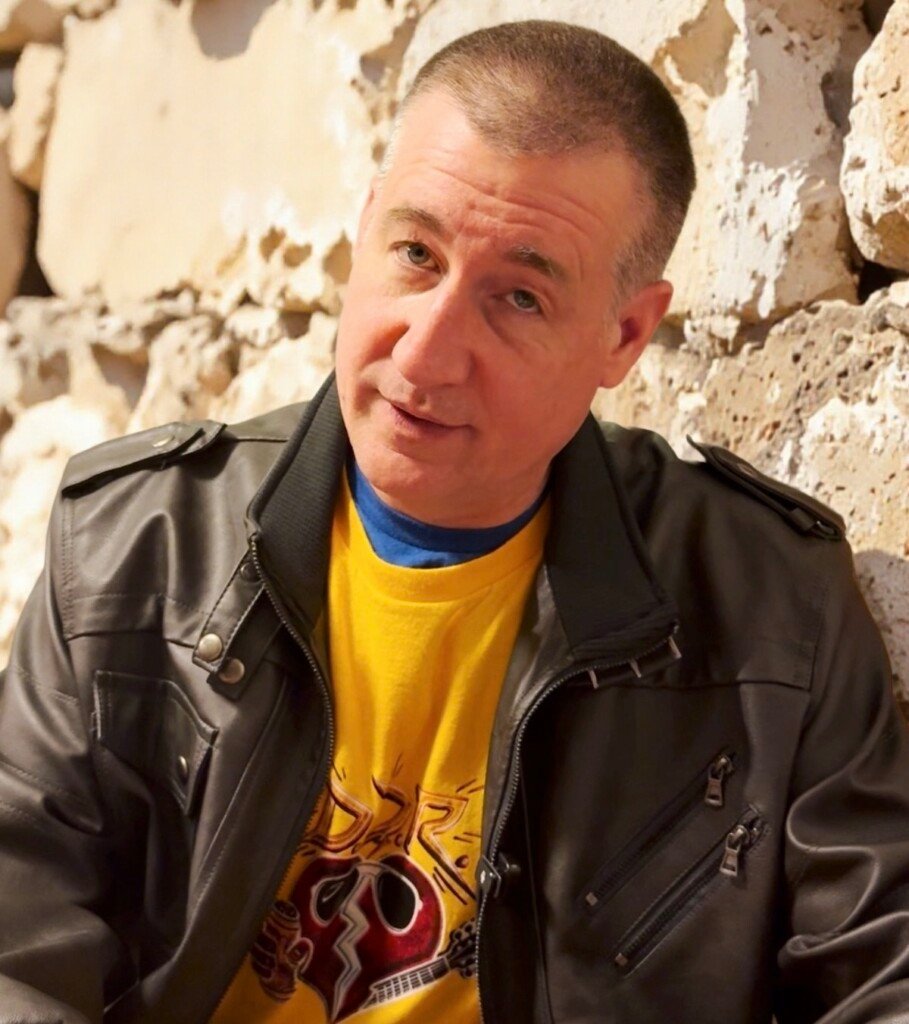
D.D.R.: I think I’m most proud of the fact that I’m fifty-something years old and still finding new ways to be creative. I still have stories to tell, and I just keep finding new ways to tell them. Who knows where that might lead me? Hell, I might even write a rock musical someday. Who knows?
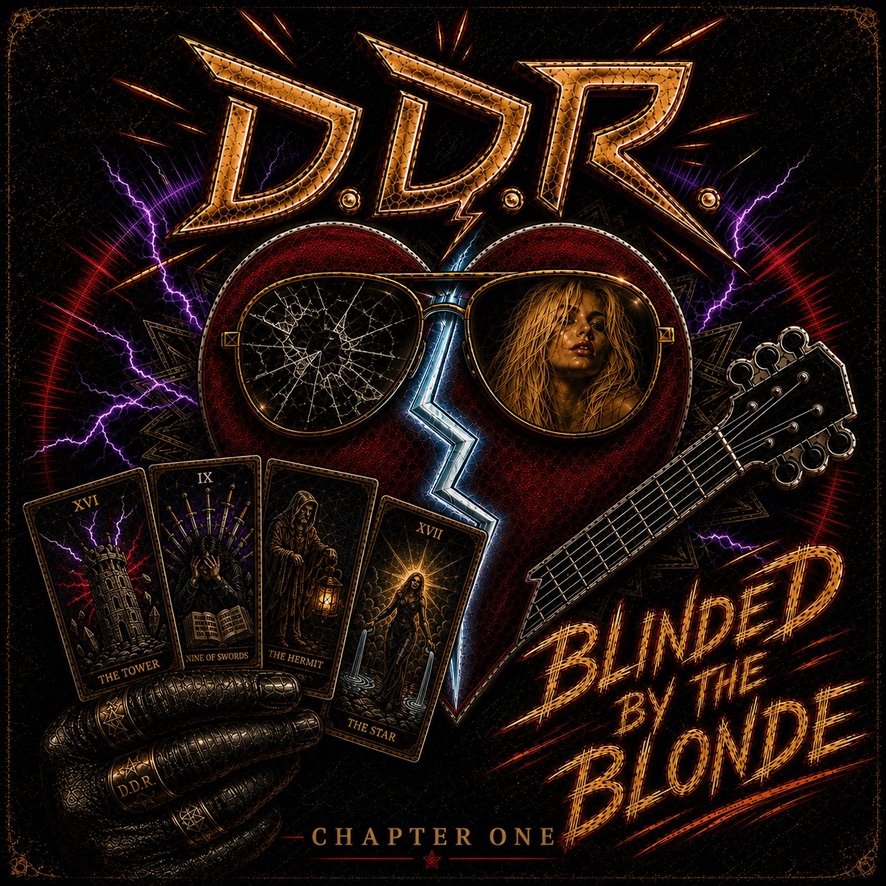
Blinded By the Blonde is the culmination of the first chapter of D.D.R. I think it highlights the emotional depth that I’m capable of writing and establishes the sound as nostalgic melodic rock with a modern edge. The first chapter deals with heartbreak, loss, grief, betrayal, and the overall complications of existing within a relationship. But it ends with hope. “Make Me Feel Again” is the perfect capstone to this first chapter as it gives a glimmer of what is to come.
The next chapter of D.D.R. is going to add a bit more personality to the musical repertoire. Whether that’s good or bad remains to be seen. LOL. For now, I’m going to spend the rest of the summer enjoying what I’ve created so far with Blinded By the Blonde.
Then, on September 30, Chapter Two begins with “Fire at Will,” and D.D.R. comes out firing on all cylinders.
I’m excited for the next chapter.
11. With social media having a heavy impact on our lives and the music business in general, how do you handle criticism, haters, and/or naysayers in general? Is it something you pay attention to, or simply ignore?
D.D.R.: Feedback and constructive criticism are essential for a writer, so I rarely shy away from or dismiss something that might make me better at what I do. That being said, sometimes criticism isn’t constructive at all, or it completely misses the mark. I don’t take it personally. If there’s something I can learn from it, great. I will try to improve on the next endeavor. If it’s just trolling or hate, I ignore it.
Unless it’s particularly clever. I’ll tip my cap to a clever slam, even if I’m the recipient.
I’m pretty content with who I am as a person and as a writer. My kids still talk to me. At the end of the day, that’s all that really matters.
12. Creative work in a studio or home environment, or interaction with a live audience? Which of these two options excites you most, and why?
D.D.R.: Man, if I could sing, I’d be belting D.D.R. songs in front of a live audience every chance I could get. But, alas, proper key, pitch, and notes are things that continue to elude me, so I’ll stick with the home studio collaboration setup I have going with Musiversal for now.
That being said, I’m truly enjoying every aspect of the production process, from the moment the spark hits to the minute the stereo master comes back. There’s something incredibly satisfying about hearing something that started in my head gradually become a finished record.
13. Do you think is it important for fans of your music to understand the real story and message driving each of your songs, or do you think everyone should be free to interpret your songs in their own personal way?
D.D.R.: Both. J I try to write in a way that is honest and clear, so everyone knows what it is that I’m trying to say. But I do also try to leave space for people to interpret the songs through their own experiences.
A song like “Don’t Tell Me How to Grieve,” for example, was written about a breakup, but it could also resonate for someone dealing with the death of a loved one, or even a friendship that faded with time. The examples in the song go back to the idea of universal specificity, which I try to incorporate for that very reason. It tells my story in a way that is specific and clear, but it’s universally relatable enough that people can find themselves in it if they choose to.
“Your tarot cards on the nightstand don’t mean a thing without your belief” could mean something different, or exactly the same thing, to any number of people.
That is the magic of words and the wonder of music.

STAY IN TOUCH:
INSTAGRAM | SPOTIFY | TIKTOK | WEBSITE | YOUTUBE