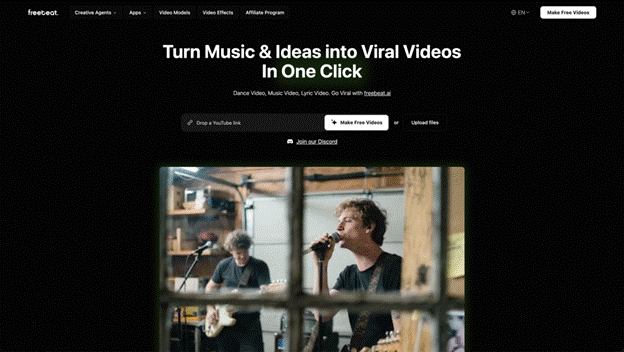
Visuals have become inseparable from how music is released, discovered, and remembered. A song might start as audio, but it often “lands” as an image, a mood board, a short clip, or a full music video. That’s why tools that connect sound to visuals quickly are getting so much attention. Freebeat AI is one example of this shift, helping artists turn a track into a music video faster by aligning visuals with the song’s rhythm and overall feel, so the first visual draft doesn’t require a full production timeline.
When we think of music videos, it’s easy to imagine them as just a tool for promotion. But in reality, they’ve evolved into an essential part of storytelling. Visuals give the music a face. They guide the audience through the emotional landscape of a song, helping communicate the narrative, whether it’s the story behind the lyrics or the mood it evokes.
Music videos have become more than supplementary content. They are now a central layer of how music is experienced. Visuals don’t simply mirror the music, they shape how listeners perceive it, turning intangible emotion into something concrete. In practice, strong visuals help define an artist’s identity, strengthen recall, and give audiences a reason to stay with a song longer than a single play.
The Role of Visuals in Modern Music Videos
Visuals in music videos are no longer there just to accompany the music. They are part of the storytelling system. A video can make a song feel bigger, clearer, or more personal depending on how it uses setting, color, lighting, movement, and symbolism. Even when the video is abstract, the visual choices can still communicate a point of view that listeners can feel instantly.
This matters because music is often consumed without context. Streaming makes songs easy to access, but it also makes them easy to skip. Visual storytelling adds context back in. It gives a track a recognizable world, a tone, and a consistent emotional language. That world can live across a full-length music video, short clips for social platforms, looping visuals for releases, and even cover art that matches the video’s palette.
How Freebeat Enhances the Creative Process
Creating a high-quality music video used to require substantial time, budget, and coordination. That’s still true for large productions, but many artists now need visuals at a faster cadence for release cycles and content platforms. Freebeat fits into this reality by helping creators generate a first-pass video quickly, then iterate on style and presentation without needing to start from scratch each time.
A key advantage of AI-assisted creation is speed paired with structure. When visuals are paced in a way that follows the track’s rhythm and energy shifts, the video feels more intentional. That’s the difference between “random pretty shots” and something that reads as a cohesive music visual. Freebeat’s positioning around beat, tempo, and mood alignment supports that kind of cohesion, especially for creators who want a usable draft early in the process.
Freebeat also emphasizes continuity tools, including character consistency and keeping multiple characters consistent in a scene. That matters when a video needs to feel like one world rather than a collage of unrelated scenes. Continuity is one of the fastest ways to raise perceived production value, even when the visuals are stylized or abstract.
Visuals and Emotion
The relationship between music and visuals goes beyond illustration. It’s about amplification. A strong visual direction can heighten a song’s emotional impact by reinforcing the feeling the track already carries, whether that feeling is urgency, softness, tension, or release. Visual choices do this through pacing, color temperature, composition, and the “grammar” of motion.
AI tools don’t replace the creative decision-making that makes these choices effective. Instead, they can make experimentation cheaper and faster. You can test different directions, then keep what feels true to the song. The creative job becomes less about accessing equipment and more about choosing a visual thesis and protecting it from clutter.
The Role of AI in Modern Music Visuals
AI tools are increasingly used as part of the music release pipeline, especially for independent artists and small teams. The value isn’t only automation, it’s iteration. When visuals can be generated and refined quickly, creators can explore more ideas, respond faster to trends, and maintain consistent branding across platforms.
Freebeat also highlights output formats like 9:16 and 16:9, which fits how music visuals are distributed today. The same track often needs multiple versions: vertical clips for Shorts and Reels, and widescreen exports for YouTube and long-form viewing. Format-ready output helps reduce the friction between finishing a video and actually publishing it.
Why This Matters
Visuals are no longer an optional add-on to music. They are a key part of how a song communicates, travels, and sticks. As AI tools mature, they are making visual storytelling more accessible, not by replacing artistic intent, but by reducing the time and cost required to explore ideas.
Tools like Freebeat are part of that shift, helping artists move from audio to publishable visuals faster while still keeping room for creative direction and iteration. The result is a music landscape where sound and image are built together, and where storytelling happens as much on the screen as it does in the speakers.
FAQ
Why do visuals matter so much in modern music storytelling?
Because visuals add context fast. They communicate mood, identity, and meaning in a way that helps audiences connect with a song instantly, especially on scroll-first platforms.
Are music videos still about promotion?
Promotion is part of it, but modern music videos are also storytelling tools. Visuals can shape how a listener interprets the track, not just help it get seen.
What kinds of visuals count as “music storytelling” today?
It’s not just full-length music videos. Teasers, hook clips, lyric snippets, looping visuals, cover videos, and vertical edits all contribute to the story a song tells across platforms.
Where does Freebeat fit into modern music storytelling?
Freebeat helps creators turn a track into a shareable music video quickly by syncing visuals to beat, tempo, and mood, so the first draft is easier to produce and iterate on.
How can creators keep visuals on-brand when using AI
Start with a clear visual direction: one mood, one “world,” and one recurring motif. Then generate a few options and curate, trimming anything that breaks the identity.
What makes a music video feel emotionally connected to the song
Pacing and progression. When visuals lift with the chorus, breathe in the verse, and shift in the bridge, the video feels emotionally aligned rather than random.
Do creators need different formats for different platforms
Yes. Vertical and widescreen behave differently. Planning for 9:16 and 16:9 early helps visuals feel native instead of cropped or repurposed poorly.
Will AI replace human creativity in music visuals
AI can speed up production and iteration, but creative direction still comes from the creator. The strongest results usually come from using AI as a draft engine and then editing with human taste.
#This is a Contributor Post. Opinions expressed here are opinions of the Contributor. Illustrate Magazine does not endorse or review brands mentioned; does not and cannot investigate relationships with brands, products, and people mentioned and is up to the Contributor to disclose. Contributors, amongst other accounts and articles may be professional fee-based.#