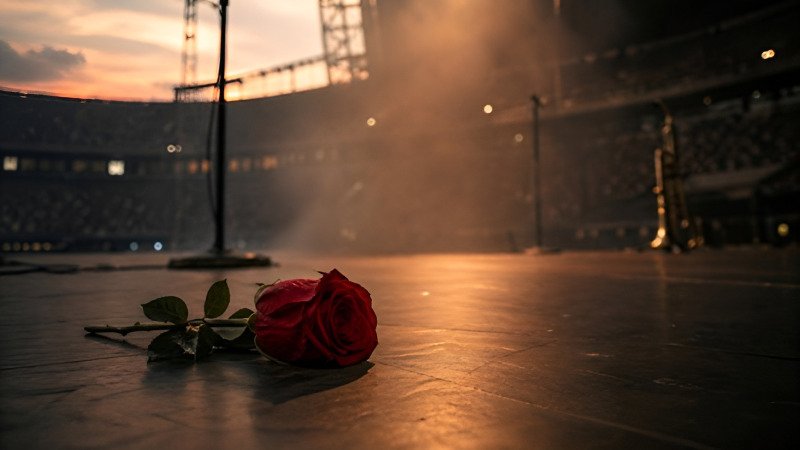

When Bruno Mars announced The Romantic Tour earlier this year, the headline figure was the gap. His last proper world trek, the 24K Magic World Tour, wrapped on New Year’s Eve 2018. The long-running Park MGM residency, which closed out on New Year’s Eve 2025 after nine years, kept him visible to anyone willing to fly to Las Vegas, but the kind of long-arc, stadium-by-stadium global run that defined his early career had not been on the table for nearly a decade. The Romantic Tour, opening April 10th at Allegiant Stadium and closing December 8th in Mexico City across seventy-eight dates, is that run. It also happens to be the tour that broke Live Nation’s single-day ticket-sales record across North America, Europe and the UK on its first day of sales, with 2.1 million tickets moved — the kind of statistic that tells you the audience had been waiting longer than even the artist seemed to realize.
The album it supports — The Romantic, released February 27th on Atlantic Records — sets the tone for what the live show is doing. This is Mars’ fourth solo studio record and the most overtly genre-curious thing he’s released since Unorthodox Jukebox. “Risk It All,” the second single, debuted at number four on the Billboard Hot 100 and topped the Streaming Songs chart on its March 14 entry with 23.2 million streams in its tracking week, but its more interesting feature is what it sounds like: acoustic guitar, restrained brass, and a bolero structure rendered with mariachi instrumentation that Mars sings in some of the most exposed vocal takes of his catalogue. It is the kind of song that would have been hard to imagine fitting between “24K Magic” and “Locked Out of Heaven” more than a decade ago. On stage, it slots in cleanly anyway, which says more about how the show is structured than about the song itself.
What lands first in the live experience is the moment the room shifts. Bruno Mars shows do not build slowly — that much is consistent across reviews of the opening leg. The arrangement of “Uptown Funk” still detonates the room with a precision that almost feels engineered, and in a sense, it is. Reviewers and audience footage from the opening dates describe the same pattern: the band hits cues with no hesitation, and the room is on its feet before the first chorus. There is a particular kind of pop performer who knows exactly how much of the show the crowd needs to perform, and Mars belongs to that category. The show is participatory in the literal sense. It is built to be sung back at.
Where this tour separates itself from past Bruno Mars runs is balance. The high-energy moments — “Uptown Funk,” “Treasure,” “Finesse,” “24K Magic” — still carry the back half of the set. But the new material, The Romantic tracks especially, brings a quieter dimension that the older catalogue couldn’t fully accommodate. Reports from the opening dates describe the same architecture: at midpoint, the production drops back, the lighting shifts to a softer amber wash, and Mars works through the slower end of the new record. The contrast is what gives the rest of the show its lift. Without it, the high-energy run would land as spectacle. With it, the spectacle reads as range.
The supporting bill is also load-bearing. Anderson .Paak, performing throughout under his DJ Pee .Wee alias, opens every date — a reminder that Silk Sonic was not a side project but a working partnership. The rotating headline support — Leon Thomas through May, Victoria Monét overseas in June and July, RAYE from August through October — is unusually strong for a stadium tour and reflects an approach to opening acts that treats the support slot as part of the artistic statement rather than as warm-up filler. For audiences, it means the night begins meaningfully an hour before Mars arrives on stage.
The runtime itself is part of the argument. Most stadium acts of this scale stretch a show toward two and a half or three hours, treating duration as proof of value — the longer the set, the bigger the statement. Mars goes the other direction. The Romantic Tour lands between ninety minutes and two hours and treats density as the proof instead. Across published setlists and tour reviews, the transitions read as almost seamless — minimal banter, no obvious gaps for costume or stage resets, the band carrying instrumental bridges that link one number directly to the next. The choice is consistent with the rest of his catalogue: where his peers maximize, Mars edits. The show stays in the room only as long as it needs to, which is the kind of decision that requires having something specific to say in the first place.
The geography of the tour reads as its own kind of statement. Where the 24K Magic World Tour in 2017–18 leaned heavily into North American arenas with a lighter European pass, The Romantic Tour moves at stadium scale across a noticeably wider grid — North America, Europe, and a closing run that lands in Mexico City rather than the more conventional U.S. coastal finale. The decision to end the tour in Latin America, on the back of an album whose most distinctive stylistic departure — the Latin-leaning second single, “Risk It All,” a bolero rendered with mariachi instrumentation — sits at the front of the running order, is not incidental. It positions Mars closer to the cross-Atlantic, cross-Latin pop axis where the centre of mainstream commercial gravity has been quietly relocating for several years. Seventy-eight dates is a number; the shape of those dates is the editorial choice.
For the version of Bruno Mars that exists right now — older, more deliberate, more interested in the arrangement than the trick — this run is the live document worth catching.
Ticket data via TicketX.
#This is a Contributor Post. Opinions expressed here are opinions of the Contributor. Illustrate Magazine does not endorse or review brands mentioned; does not and cannot investigate relationships with brands, products, and people mentioned and is up to the Contributor to disclose. Contributors, amongst other accounts and articles may be professional fee-based.#