Barlow has a unique style blending Pop, R&B, Rock, Folk, and Blues with the precision of a digital composer and the vulnerability of a confessional songwriter, Bill Barlow crafts a body of work that feels both intimate and expansive. These songs don’t just play — they provoke. They ask questions. They linger. Barlow is sonically rich and immersive. He weaves warm analog textures through digital precision. His melodies sneak into the ears and set up permanent residence, while Barlow’s signature lyrics cut with clarity and emotional honesty. It’s a listening experience that lands instantly, lingers deeply, and rewards every replay. Check out the exclusive Interview below:

1. Your roots can often shape your journey. Can you share a story or moment from your early life that had a significant impact on your path into music?
Bill Barlow: I found myself writing a lot of poems. A friend of mine picked up one and started playing his guitar and began to sing it. Immediately I felt like a songwriter. Then shortly after that I was at another friend’s house and the neighbor was there. He was a semi famous jazz singer called Harry “the Hipster” Gibson. He saw me carrying a handful of poems and asked me what they were. I said that I was a song writer. He laughed and said Son, until someone pays you for work you aren’t a song writer. He asked me to them. He read a few and stopped saying, “this is good”. He reached into his pocket and handed me 50 bucks and said, “Son, you are a songwriter now.” Evey poem I have written since has been a song.
2. Did your musical journey begin with formal training, or was it more of a personal exploration? How has that shaped your unique approach to your craft?
Bill Barlow: I took some guitar classes when I was a teenager and played the clarinet in my middle school band. I was awful. I played with the keyboard until I was a moderate player. I’d say that most of my skills now are self-taught. I produced music and video for several years mainly for commercials, but that experience was what really gave me the foundation to develop my craft. In the ad world you get pretty direct, even harsh responses to your work. It’s either great and it sells or people hate it and you don’t get hired again. Through this I developed a reasonably good instinct of what is good, what people like etc.
3. Who were some of the most influential figures in your early musical life, and how did they inspire your sound? Also, what’s the story behind choosing the name ‘Bill Barlow’?
Bill Barlow: Bill Barlow is my actual name, not a stage name, so that one was easy. I never considered creating a persona or a brand. Early on I was influenced by many singer songwriter folks. Since writing lyrics is first for me, people who told stories always got my attention. Early on there were people like Paul Simon, who also was diverse musically. I liked Jimmy Buffett a lot and Eric Clapton. But Rob Thomas was a huge influence on me. I love the way he can tell a story in a way that feels natural. You can absorb the words or ignore them and the song still works. He has the whole package and has been someone I study and admire.
4. What do you believe sets your music apart? How would you describe your sound to someone discovering you for the first time, and what emotions or experiences do you hope to evoke in your listeners?
Bill Barlow: My “lane” is emotional conveyance. I write about emotional situations and feelings. The music compliments the lyrics. But the song is designed to evoke feelings in a way that you normally don’t get on pop radio. If you take time to study my words you will find something deeper than what you may expect. I like my music to live with you in a way that makes you think about it when you are faced with the same situation.
5. For most artists, originality is first preceded by a phase of learning and, often, emulating others. What was this like for you? How would you describe your own development as an artist and music maker, and the transition towards your own style, which is known as EMO?
Bill Barlow: Because I begin and end conveying an emotional feeling, I do not bind my musical style to a single genre. I blend several musical influences across many styles to make what I feel is unique. And since the industry loves to categorize, I call that EMO, short for emotional. If you have a white cake recipe and add chocolate, it’s still cake. But I see myself as adding many ingredients (influences) from a wide variety of people and genres. When I’m finished, it may be hard to define what the flavor is, but it’s still cake.
6. Music often transcends entertainment. What’s your view on the role and function of music as political, cultural, spiritual, and/or social vehicles – and do you try and affront any of these themes in your work, or are you purely interested in music as an expression of technical artistry, personal narrative, and entertainment?
Bill Barlow: I personally believe that music has the ability to unite people from all walks of life and a myriad of opinions. For this reason I stay away from subjects that are too political or otherwise divisive. My personal narratives or intimate stories are meant to illustrate an emotion position that hopefully everyone can relate to. I want you to be entertained and absorbed into the work without trying to influence you toward any specific agenda.
7. Do you feel the rewards of your musical career match the energy and passion you invest in it, or are there different kinds of fulfillment you’re still seeking?
Bill Barlow: I genuinely feel rewarded when I see someone else tapping their toes to my work or singing along. It tells me that my creative instincts were good and the creative has resonated with people. But the energy that goes into my songs is usually quite intense. I scrub through second by second, track by track and line by line of each song trying to get what is in my mind to come through the speakers down to the coma. Sometimes when I play back the final mix, I actually cry thinking about how all of my effort has now been realized. So ultimately, I am seeking to get my music heard on a wider scale, radio, movies even having it covered by others. That is my long-term goal.
8. Can you walk us through your creative process? From the first spark of an idea to the finished track, what’s the most essential part of your process, and how do collaboration or external influences shape your work?
Bill Barlow: I get random ideas daily. I think of a line or an expression, and I wonder if I can think of enough to write a whole song. Often, I capture the idea and it sits there until the muse arrives and says, “it’s time.” Then I read it over and over while I refine how to musically compliment this story. I often hear the words together with the music in my head as I’m writing it. I find when I deviate from that musical style, it usually doesn’t come out right. Then I make a rough track to work on. Almost never do I end up using any of that material in the final mix. I work on the tracks instrument by instrument until I’m happy. I’ll often rewrite or reshape lyrics to better fit the music and finally things come together. When I collaborate, I lean into the style of my collaborator. I like to let their creative flow happen organically. But I usually end up mixing a couple of variations for us to pick from. I enjoy the back and forth pushing creative styles. The outcome is often more than one plus one.
9. What’s been the most challenging hurdle in either your personal life or music career, and how has it shaped you as an artist?
Bill Barlow: I used to ghost write for name artist. The biggest hurdle was to no longer be the ghost. The record companies have a persona and style they are looking for at any given time. I am not the guy who fits into that box. My style is unique, I’m outside of a single genre and nobody wants to create a new category for me. I’m happy writing songs for others, don’t get me wrong, but I have so much more to offer.
10. On the flip side, what moment or achievement in your career so far has made you feel the proudest, and why? And let’s talk about your latest release and future plans.
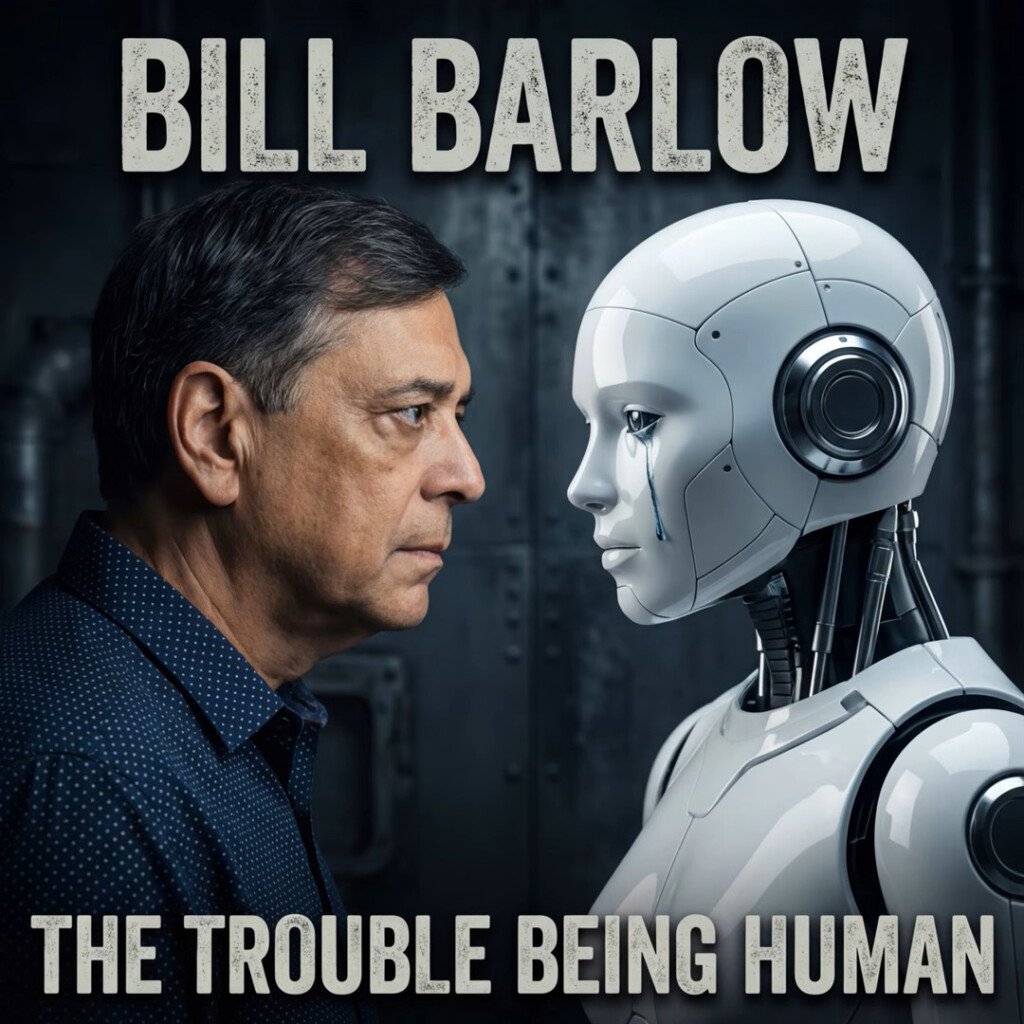
Bill Barlow: Every artist wants to be heard. We spend a lot of time promoting ourselves just so people will listen. Most times I have to tell people who I am, what I’m doing and hope they listen. I walked into a bar in New Orleans to chill after walking around all day. I was sipping on a glass of wine when I heard one of my songs being played on the sound system. Most likely someone playing a Spotify playlist. Then a stranger down the bar yells to the barmaid, “Hey, turn this up.” That was a pretty cool moment for me. The title track of my latest release, The Trouble Being Human, is already getting a lot of attention. I took on the subject of what happens when we are replaced by machines? If AI was fully in control now, they could write songs, perform melodies and work the algorithms so that they would succeed and chart. Most of will face AI influence head on in our daily life. The question is, what are we going to do about it and where does that leave us?
11. Do you think is it important for fans of your music to understand the real story and message driving each of your songs, or do you think everyone should be free to interpret your songs in their own personal way?
Bill Barlow: Most of my material is a transparent flow of an emotion. That being said, I try not to make it so specific that you can’t interpret it or adapt it to your personal situation. I want people to assign their own meaning and feeling to my work and make it personal. Many of my songs have unique stories that may never be told for this reason.

STAY IN TOUCH:
FACEBOOK | INSTAGRAM | SPOTIFY | TIKTOK | YOUTUBE