Rusty Reid is a Houston, Los Angeles, Seattle singer-songwriter writing melodic, guitar-oriented pop-country-rock songs, including many with modern liberal philosophical, political, spiritual content. Check out the exclusive Interview below:
1. Your roots can often shape your journey. Can you share a story or moment from your early life that had a significant impact on your path into music?
RUSTY REID: Hey there, and thanks for the interview. Yes, my journey into music started very early. Many of my relatives, including my mother, were musicians and singers, so that opened the portal for me. None of them, to my knowledge, were composers or songwriters, however. So it was a surprise that when I was maybe eight or nine, already playing piano, I began humming original melodies, most often when riding in the car on longer trips. No lyrics as of yet, just melodies that I had never heard before, but out they came. Something clicked. I realized, hey this is something I’m actually kind of good at, at least for starters. As I wasn’t good at anything else, this seemed like a promising endeavor. Some years later the Beatles came along, and I thought, Oh yeah, that’s what I want to do.
2. Did your musical journey begin with formal training, or was it more of a personal exploration? How has that shaped your unique approach to your craft?
RUSTY REID: There were formal piano lessons as a child which I very much enjoyed at first but then, with the death of my first teacher, I hit a plateau and then a waning of interest. Pop music most inspired me, and I figured the guitar might be more suited to my abilities and aspirations. Me and a billion other kids, at that time. I took a few guitars lessons, then decided, as many do with guitar, I’m just going to figure this out for myself. That’s usually a mistake. Not being a natural prodigy of any kind, I should have hung in there with guitar lessons. I’m sure I would be much better today. But early on, I had identified composing or songwriting as my real talent, and I felt I was a decent enough singer to get by. Each of those convictions was highly suspect in retrospect. It is indeed a wonder that I kept writing really bad songs for a really long time before coming up with a few that I actually liked, myself.
3. Who were some of the most influential figures in your early musical life, and how did they inspire your sound? Also, what’s the story behind choosing the name ‘RUSTY REID’?
RUSTY REID: Rusty Reid is a childhood nickname, and I’ve always liked the alliteration, kind of like Roy Rogers! The Beatles are far and away my primary influence, for better and worse sometimes. Otherwise, Hank Williams might have been the most important secondary mentor, as a singer-songwriter. My mom had his Greatest Hits album, which I played incessantly in my formative years. Later I was open to embracing all kinds of pop, rock and R&B artists.
4. What do you believe sets your music apart? How would you describe your sound to someone discovering you for the first time, and what emotions or experiences do you hope to evoke in your listeners?
RUSTY REID: I’m not breaking any new ground in the “sound” department. My catalog is pretty well rooted in basic folk, pop, rock and country. Maybe the blend of genres in my work is sort of unusual these days. But what I try to bring in every song is a compelling theme conveyed by interesting, and hopefully somewhat poetic, lyrics, all couched in an original, appealing melody, arrangement and instrumentation. Although I’m not the greatest musician in the world, I do look for contributing players to be excellent at their craft, and I give them pretty wide latitude to make the song theirs, as well as mine. Plus my vocals, which listeners seem to either really like or firmly don’t like. Probably more than emotion, I’m seeking to stimulate the rationality of listeners to consider the theme at hand. However, in my personal spiritual journey I have fallen so deeply in love with the world, and the Universe beyond, that I’ve lately been trying to convey that in some of my songs, hoping that the listener might step with me through that magical portal of loving the ALL. Anyone can do it; it’s just a matter of whether you will, or if you wish to remain in the realm of dull selfishness.
5. For most artists, originality is first preceded by a phase of learning and, often, emulating others. What was this like for you? How would you describe your own development as an artist and music maker, and the transition towards your own style, which is known as FOLK?
RUSTY REID: Ha. The word “folk” has changed so much in the past few decades. It used to be that “folk” was old-time bards and balladeers singing songs indigenous to a particular region, or more recently stripped-down acoustic acts such as Pete Seeger or early Bob Dylan. I’ve never thought of myself as that kind of “folkie,” Yet I get where you are coming from in the modern sense of the “genre.” And some of my primary influences, say Hank Williams, were not far from that. Yet I was more drawn to fully-fleshed out instrumentation, which requires a band, or even an orchestra, to achieve a more sophisticated “soundscape.” So you think of the Beatles and Beach Boys and Simon and Garfunkle and Glen Campbell and Creedence Clearwater Revival and the Doors and Jimi Hendrix and Led Zeppelin and Pink Floyd and Tom Petty and the Eagles, and such. We wouldn’t have ever called any of them “folk” back in the day. They all had their own “sound” that was almost instantly recognizable. These were some of the acts that riveted my attention, and I wanted to emulate. It was impossible at first, but eventually I managed to produce soundscapes that sounded good to me. I’m doubtful I’ve achieved my own “sound,” because I’m all over the map playing with these genres, plus I use so many different musicians in my work. Yet, really, perhaps I never wanted my own sound. My biggest influence was the Beatles. And what I liked best about them was that they continued to grow and explore and change. They started off with a definitive “sound,” but by the end, they had no “sound” of their own. Each and every song was totally unique, a “sound” unto itself.
6. Music often transcends entertainment. What’s your view on the role and function of music as political, cultural, spiritual, and/or social vehicles – and do you try and affront any of these themes in your work, or are you purely interested in music as an expression of technical artistry, personal narrative, and entertainment?
RUSTY REID: Yeah, good question. I see music as an artform, first and foremost. And certainly one of the higher arts. It’s the only art that the receiver can’t see. So it is processed by different parts of the brain and body. It’s also one of the few arts that vibrates the physical self. So there is great psychic and physical potential to pierce right into our very soul that comes to us through music. Some music features a great deal of “technical artistry,” but I don’t think that’s a necessary component. You can be a simple strummer or plinker and produce a piece of music that is profound. I think the “entertainment” character of music is the least important. That’s a skill in itself, sure, but one that doesn’t generally have the deepest of meaning for the listener. I’ve certainly fallen for enough cleverly delivered cute, funny, quirky, eminently danceable songs in my life, but the music that means the most to me, most moves me, and I think most people, is that which reaches for a higher plane of thought and/or emotional response. I’ve written my share of “silly love songs,” but lately I have been trending toward more philosophical, spiritual, political and personal themes and lyrics, still trying to match them up with interesting melodies and arrangements and instrumentation. I’m looking to share my outlook about the world around us, and hope that some listeners will not just be entertained by the sound but will find something useful in their own journeys.
7. Do you feel the rewards of your musical career match the energy and passion you invest in it, or are there different kinds of fulfillment you’re still seeking?
RUSTY REID: From the standard perspective of “rewards,” I’m an utter failure as an artist (or “entertainer”). I’ve achieved no fame, no fortune, no great reputation, no avalanche of accolades. But for me, being a singer-songwriter is an important part of my self-identity. In the scheme of things, I’m not the one to decide how good I am, but I have had loads of fun along the way. I remember the first 50 songs or so I wrote, I disliked. They weren’t good enough, according to my own standards. I wasn’t one of these artists who love everything they produce just because it’s theirs.
Slowly but surely learning how to craft a song was a great learning process. And eventually writing a song or two that I actually liked was a wonderful feeling. I’m still my worst critic, and so when I do write something that I feel is close to what I imagined, and holds together in its component parts, I still get that same feeling. And that’s just the writing phase. There’s also the recording, which involves arranging and playing, usually with a group of other people. That’s a whole different realm of challenge and fun. First and foremost, artists must create for themselves. The real reward is the journey itself. It’s like climbing a mountain. The view from the peak is grand, if you make it there, but it is the trail up and down that is the true adventure.
8. Can you walk us through your creative process? From the first spark of an idea to the finished track, what’s the most essential part of your process, and how do collaboration or external influences shape your work?
RUSTY REID: There are so many ways to come at writing a song. Whatever works for you. In my earlier years I would usually sit down with a guitar, or at the piano, and doodle around until something spilled out. Often it was something that was nowhere in my brain before the sit-down. More often now, I have a title, or at least a theme, in mind before I start doodling. Sometimes songs come quickly, other times I’ll take several days or longer before getting it shaped up. Then I’ll do a demo of it myself, and this is the phase where I’m double-checking that these are words and the chords and the melody I really want. Once I’ve got that demo sorted out, I’ll think about which of my key multi-instrumentalist collaborators might be best for this song and arrangement I have in mind. I’ll send them my demo for reference, and they send back their backing tracks as a brand new project. At this early juncture, I give them a lot of freedom to “make it theirs.” I want their “stamp” on it. Once returned, I’ll do my vocals and any instruments I want to add. Typically I’ll enlist a drummer and bass player to perfect what we have. If you listen to my new single, “The Meaning of Life,” you’ll hear how this plays out. I sent a demo over to multi-instrumentalist Ronan Dempsey in Ireland, who sent back digital drums/simple bass, keyboards and his acoustic and electric guitars. I then added vocals and my guitars, and replaced Ronan’s basic bass/drums with Nashville cats Isaac Wriston and Hubert Payne. And I think we got a pretty sweet, and meaningful, song out of the process.
9. What’s been the most challenging hurdle in either your personal life or music career, and how has it shaped you as an artist?
RUSTY REID: Oh, gosh. I have had an amazing life. By most metrics, I’ve been a failure at everything. Music career. Non-music career. Personal relationships. But I have traveled the globe, and delved deep into the realms of the mind and spirit, helped along by the greatest thinkers and feelers of history. It’s been such a grand journey, culminating in becoming simply madly in love with the world. It really doesn’t get any better than that. I’m fully aware of how privileged I have been, and that understanding leads me to ever be on the side of the oppressed, whoever or whatever they may be.
10. On the flip side, what moment or achievement in your career so far has made you feel the proudest, and why? And let’s talk about your latest release and future plans.
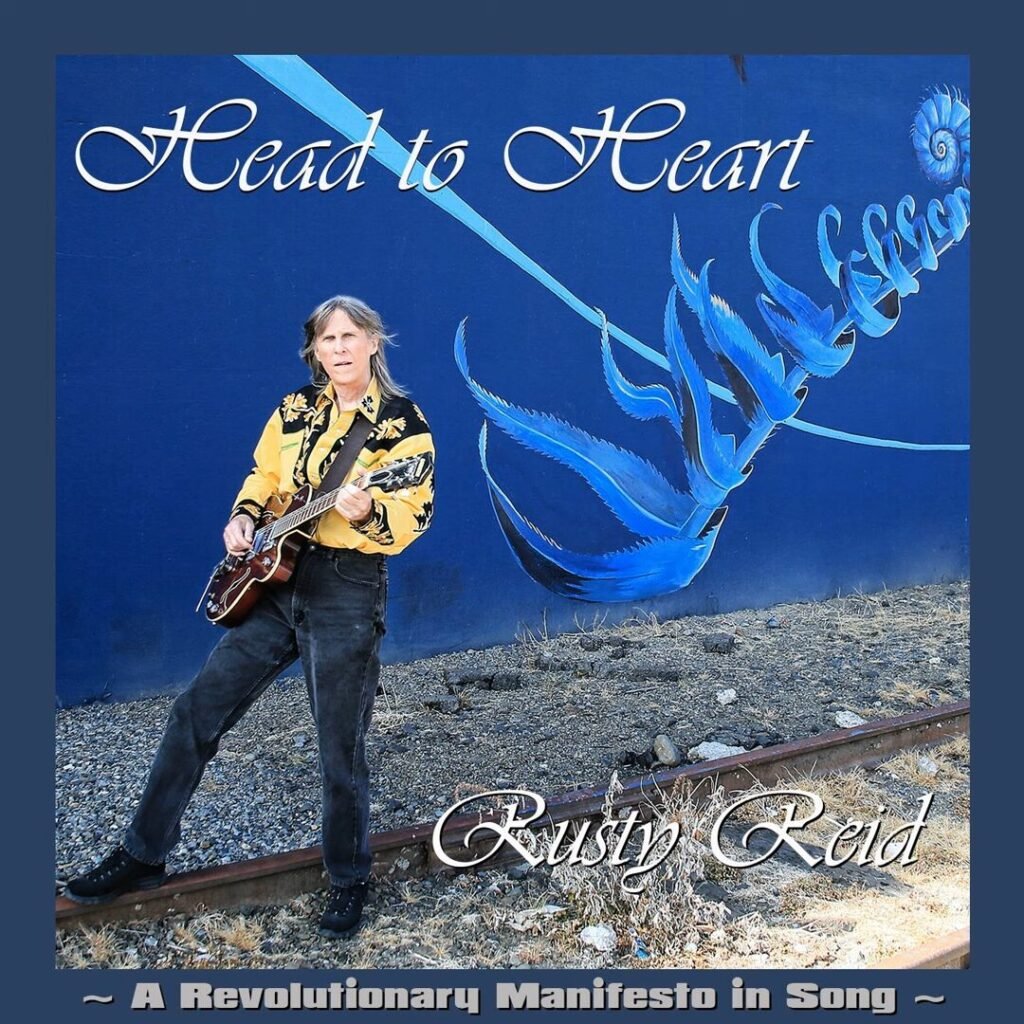
RUSTY REID: The release of my second album, “Head to Heart,” was important to me in many ways. I call it a “Revolutionary Manifesto in Song.” It’s basically my worldview summed up in one album. It was 18 years between that album and my first release (“NWXSW”). My mother died just as the second album was commencing, and I feared that emotional blow might halt the procession of the album project. That I could even write it, get it recorded, finish it and release it was something of a miracle. Overcoming those obstacles was a big relief. At least I accomplished this, I thought. The process of completing that album set me on the pathway to continue on. I released my third album (“Bayou Line”) in 2023, and I have a new album coming out next year. Currently I’m promoting the remix release of “Head to Heart,” at the five year anniversary of the initial release.
11. Do you think is it important for fans of your music to understand the real story and message driving each of your songs, or do you think everyone should be free to interpret your songs in their own personal way?
RUSTY REID: I typically don’t write abstract or metaphorical lyrics. Generally, I have something to say and want to clearly state it, hopefully poetically. So my songs are structurally less open to personal interpretation than those of many artists. I admire writers and poets and songwriters who are adept at mysterious word-play, but when I hear a writer admit, “I don’t know what it’s about,” I’m thinking, well you apparently didn’t really have anything to say. I have a lot to say. Like in my new single off the 2024 Remix of “Head to Heart,” the song, “The Meaning of Life.” With this song, I’m actually tackling one of the most vexing questions in human history. Sages and philosophers and poets and thinkers have been arguing about this for millennia. So I went in search of the true answer, believing there must be a solution to the riddle. On this quest I noticed something critical. Almost every one of these sages and poets considered the question strictly from the human angle. I found this very odd. I thought we were considering the meaning “LIFE!” Why are they stubbornly refusing to factor in every other LIFE form that ever lived? The key to the riddle was lying right there in plain sight, but everyone was missing it because of human self-absorption and hubris. I picked up that key and turned it over and over, wondering what door will this unlock that will open to the answer of this ancient question? It should be something simple, basic, applying to every single life form, even the simplest prokaryote, It should be something that each and every life form is singularly focused upon. It seemed to me that it could not be a “state” of being, as these are usually fleeting and unsustainable, thus providing meaning then non-meaning. It could not be something done just a few times in life, or something that vast numbers of living things never do. I began to think it must be an impulsive activity or “process.” Then one day, I was researching Thomas Jefferson’s “Declaration of Independence.” The most famous phrase of that work actually came from English philosopher John Locke, but Jefferson changed Locke’s “Life, Liberty and Property,” to “Life, Liberty and the Pursuit of Happiness.” Wow. There it was: the answer right in front of us the whole time. The key slipped into the door. What do “life” and “liberty” serve? The pursuit of happiness! That’s what all life is doing, all the time (with timeout for rest, then right back to it). To me it’s incredibly profound that we are here—all of us living things—for the chance to pursue happiness. How beautiful is that? What a wonderful world. Of course, I had to get that into a song as soon as possible. The result was my “The Meaning of Life.” Hope you’ll give a listen, and a ponder.

KEEP IN TOUCH:
FACEBOOK | INSTAGRAM | TWITTER | SPOTIFY | BANDCAMP | WEBSITE | YOUTUBE