
By Million Wires is an alternative band from Tarnów (Southern Poland). Since 2007, the group has been creating music on the edge of dreamy post-rock and alternative sensibility, searching for the perfect connection between the chaos of effects and melody. Their well-received debut, “Letters to the Absent” (2012), was praised for its spacious guitar sound, sensitivity, and skillful mood-building. It was a lyrical story led by the unique voice of Anna. In 2026, the group breaks the silence with the soon to be released EP “Not Over”. The new material marks a departure from etherealness in favor of a more direct and raw sound, driven by Mirek’s vocals. It is music full of contrasts, space, and raw emotional weight. It is proof that some stories simply have no end. Current line-up: Mirek Skrok (voc/git), Dawid Moździerz (git), Mateusz Ostafil (bass), Dawid Remian (dr). Check out the exclusive Interview below:
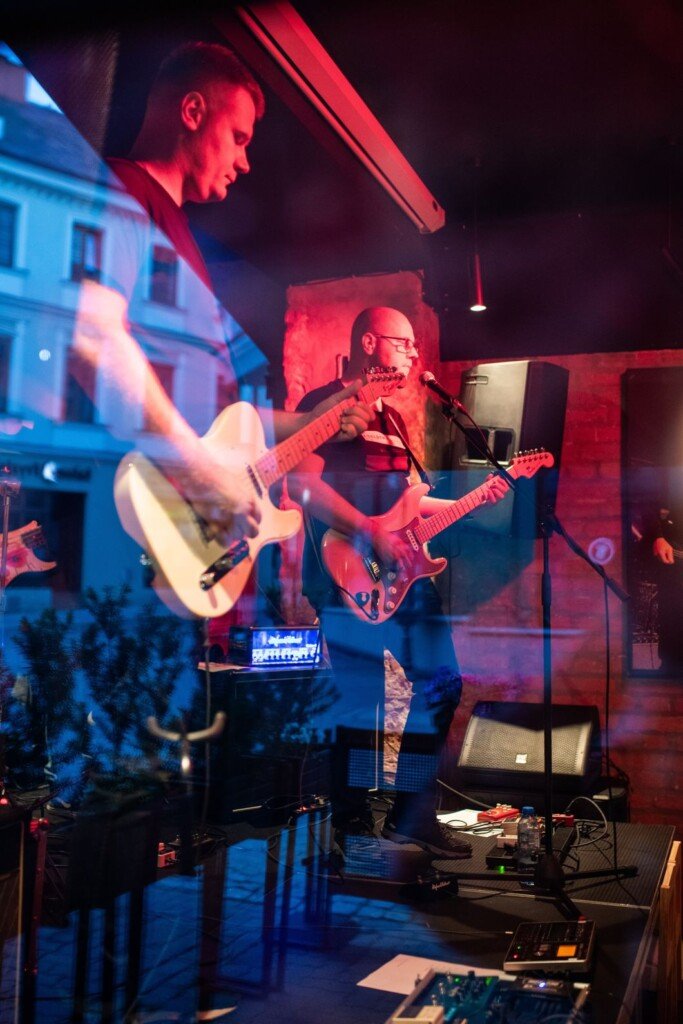
[Note – all answers are given by Mirek Skrok from By Million Wires and this should be noted that where the 1st person is used, it is referring to personal opinion of Mirek]
1. Your roots can often shape your journey. Can you share a story or moment from your early life that had a significant impact on your path into music?
BY MILLION WIRES: Music has been my constant companion since I was a child. Both my mother and grandmother were piano teachers, and besides their work at the music school, they also gave private lessons at home. As a result, the sound of the piano was essentially the soundtrack to my life from morning till night. I started playing very early, which eventually turned into a formal education at a music school, so it always felt like a natural part of my existence.
However, I have to point out that this was all classical music. Back then, I perceived it as ‘nobler’ than the pop or rock I heard on the radio, and for a long time, I couldn’t really listen to anything else. The turning point came with a few specific songs that opened my mind to popular music. I vividly remember the track ‘Promises’ by The Cranberries, which was being heavily promoted at the time. I bought the cassette with the conviction that I probably wouldn’t even like it, but the entire album completely consumed me. From there, it was a snowball effect, leading me to discover bands like Smashing Pumpkins, Nirvana, U2, and so many others.
2. Did your musical journey begin with formal training, or was it more of a personal exploration? How has that shaped your unique approach to your craft?
BY MILLION WIRES: My journey was somewhat unconventional. As I mentioned, I started with classical music, which gave me a very solid foundation in music theory, performance, and various technical aspects. However, what I constantly felt was missing was the space for originality and personal expression—simply put, the act of composing. In a music school setting, you are expected to perform a piece exactly as the composer wrote it down. That doesn’t always align with how you ‘feel’ the music in your heart at that particular moment.
For a long time, the piano was associated with recreating someone else’s thoughts and emotions. The turning point was picking up the guitar. It became a source of immense inspiration for me, both in terms of its raw sound and as a vessel for my untapped desire to create my own music. Looking back, I can see how these two worlds—the classical and the rock—complement each other now. But initially, compared to my bandmates, I found it a bit more challenging to truly settle into the ‘vibe’ of performing and experiencing rock music live on stage.
3. What do you believe sets your music apart? How would you describe your sound to someone discovering you for the first time, and what emotions or experiences do you hope to evoke in your listeners?
BY MILLION WIRES: I must admit, it’s quite difficult for me to describe our music with words. Mostly because we always tend to reference our inspirations—musicians we consider geniuses—which can sometimes give the listener unrealistic expectations that our work will match that same level. However, if I had to introduce our sound to someone, I’d describe it as spacious, atmospheric, guitar-driven music with distinct, melancholic melodies.
It’s music that speaks to those looking for a ‘deeper layer’ or perhaps hidden emotions. It’s meant to provoke thought and introspection, and hopefully, lead to a sense of catharsis. It’s definitely not something you can dance to, and it might not be a ‘love at first sight’ experience. But over time, you start to notice the layers and nuances that were hidden at first. In that sense, I’d compare it to a fine, mature wine.
4. For most artists, originality is first preceded by a phase of learning and, often, emulating others. What was this like for you? How would you describe your own development as an artist and music maker, and the transition towards your own style, which is known as ALTERNATIVE/INDIE ROCK?
BY MILLION WIRES: Given my background in classical music and discovering the rock guitar later in life, my perspective on original and independent music is a bit different from my bandmates. Right from the start, I barely played any covers. I set a goal for myself: inspired by my idols, I wanted to immediately translate those emotions into my own compositions. Generally, I wouldn’t recommend this approach to anyone—lacking technical guitar skills meant I spent a long time wandering in the dark, coming up with some truly terrible melodies.
It was meeting Mateusz and the Davids in the band that finally broke the ice. Playing a few shared “anthems” together, like Radiohead’s Karma Police or PJ Harvey’s The Whores Hustle and the Hustlers Whore, unlocked something in me. It taught me that I don’t always have to play perfectly. Instead, through spontaneity and improvisation, I finally felt that playing rock is, above all, about “fun.”
So, like almost every band, we had a phase of playing covers at the beginning, but we all agreed that our priority was original material. We quickly started gathering ideas and experimenting. By the time Ania Ostafil joined us, we already had a wealth of material for her to sing to. Each of us brought different inspirations to the table, but the essence of our style was already captured on our 2012 debut album. The following years have, of course, been an evolution—we constantly feel that we are becoming better musicians.
5. Music often transcends entertainment. What’s your view on the role and function of music as political, cultural, spiritual, and/or social vehicles – and do you try and affront any of these themes in your work, or are you purely interested in music as an expression of technical artistry, personal narrative, and entertainment?
BY MILLION WIRES: I believe music is one of the most powerful social and emotional vehicles we have. While we don’t aim to be a political band, I see our music as a social connector. It’s about that shared feeling when a melody hits you in a way that words alone can’t—that’s where the spiritual element lies for us.
In our work, especially on ‘Not Over’, we lean more towards personal narrative and emotional resonance than technical showmanship. We aren’t interested in just ‘entertainment’ or ‘technical artistry’ for the sake of it. For us, music is a way to document the human condition—the highs, the lows, and the spaces in between.
Even if a song starts as a personal story, once it’s released, it becomes a cultural vessel for the listener. If someone finds comfort or a sense of belonging in our sound, then the music has fulfilled its most important social function. We want to create a sonic space where people can feel understood.
6. Do you feel the rewards of your musical career match the energy and passion you invest in it, or are there different kinds of fulfillment you’re still seeking?
BY MILLION WIRES: Since we are still an independent band and, practically speaking, remains unknown to the mainstream audience, commercial success—or the lack thereof—isn’t a burden for us yet. That being said, my ultimate goal has always been simply to create music that I would want to listen to myself. It’s no easy feat, though, because as the saying goes, you are your own worst critic.
For me, the best way to gain perspective is to step away from the composing process for a while. When I revisit my ideas with fresh ears, I can usually make a definitive verdict on what to keep and what to scrap. Finishing a piece of music that I’m proud of brings immense satisfaction. It’s a type of creative fulfillment that is incredibly hard to find in the ‘daily grind’—especially when you’re balancing a professional career and music is, technically, a passion project.
7. Can you walk us through your creative process? From the first spark of an idea to the finished track, what’s the most essential part of your process, and how do collaboration or external influences shape your work?
BY MILLION WIRES: Most of our songs originate from a guitar or bass riff. We usually start by jamming together to capture that initial spark, but after the first sketch, the heavy lifting happens at home—either by myself or Dawid Moździerz. I’ve been recording my own music since high school, so using a DAW (Digital Audio Workstation) has become an essential part of my daily routine for building drafts to present to the band.
At the following rehearsal, we turn it into a collective effort where everyone develops their own parts. It’s particularly crucial for Dawid Remian and Mateusz, our rhythm section, to bring a unique beat and energy to the composition. Now that I’ve stepped into the role of vocalist as well as guitarist, this workflow of refining songs at home has become even more vital; it gives me the space I need to focus on lyrics and vocal melodies. Of course, some tracks are purely the result of spontaneous jams, like ‘Ketonall’ from our first record. On the other hand, I also have a catalog of complete solo songs—such as our single ‘I Know Better’—which I bring to the band to see if we want to evolve them together.
8. With social media having a heavy impact on our lives and the music business in general, how do you handle criticism, haters, and/or naysayers in general? Is it something you pay attention to, or simply ignore?
BY MILLION WIRES: For any artist, learning how to handle negative feedback is essential. Our music is deeply personal—almost like a sonic diary. When you put yourself out there, you accept that it won’t be everyone’s cup of tea. We handle criticism by filtering its source. If it’s just a random, fleeting comment on social media, we don’t take it to heart. However, if the feedback comes from a respected journalist or a fellow musician, we listen and try to understand their perspective. It’s only human to feel a bit stung, but it’s important to find constructive points that can help us improve.
On the other hand, I vividly remember a review of our debut album. The author was a member of a band we had actually shared a stage with. His review was scathing, claiming our music lacked innovation and was borderline plagiarism. He even went as far as cross-referencing our tracks with specific bands he thought we were copying. What I found amusing was that I hadn’t even heard of almost any of the artists he mentioned! At the end of the day, we aren’t reinventing the wheel—or the chords. Someone, somewhere, has definitely used them before :)
9. Creative work in a studio or home environment, or interaction with a live audience? Which of these two options excites you most, and why?
BY MILLION WIRES: These are two vastly different experiences, yet both are equally vital. Playing live is where the music truly comes to life. It’s fascinating to witness the audience’s reaction to our music—which isn’t always ‘easy-listening’—especially in small, dimly lit, intimate venues. I’m always surprised when parts of a song I was once unsure about suddenly shine on stage, and people truly connect with the experience. That’s pure magic.
That said, for an indie band like us—especially one returning from such a long hiatus—the studio and rehearsal space are where we feel the most creative and free. From my perspective as a composer and lyricist, I need to see the potential of the music in a controlled environment before sharing it with the world. I suppose that stems from my classical background and those years of solitary, quiet practice.
10. Do you think is it important for fans of your music to understand the real story and message driving each of your songs, or do you think everyone should be free to interpret your songs in their own personal way?
BY MILLION WIRES: My lyrics are quite personal, but they aren’t intended to be literal recounts of my past. Instead, they are momentary impressions of a feeling or a thought that moved me. There is a specific ‘story’ behind each one—for example, ‘Glass Houses’ was written upon my return to Poland after a long stay abroad—but I truly want the listeners to project their own experiences onto the words. That’s exactly why my lyrics can be a bit vague in places; it creates a space for the listener to fill with their own emotions, people, or memories.
Personally, that’s how I consume music myself—through the lens of my own history. Although, I must admit, sometimes an artist’s imagery is so vivid and compelling that it makes me want to dive deep and research exactly what they were thinking and what the circumstances were at the time of writing.

STAY IN TOUCH:
FACEBOOK | INSTAGRAM | SPOTIFY | BANDCAMP | TIKTOK | YOUTUBE
Review by: Naomi Joan