
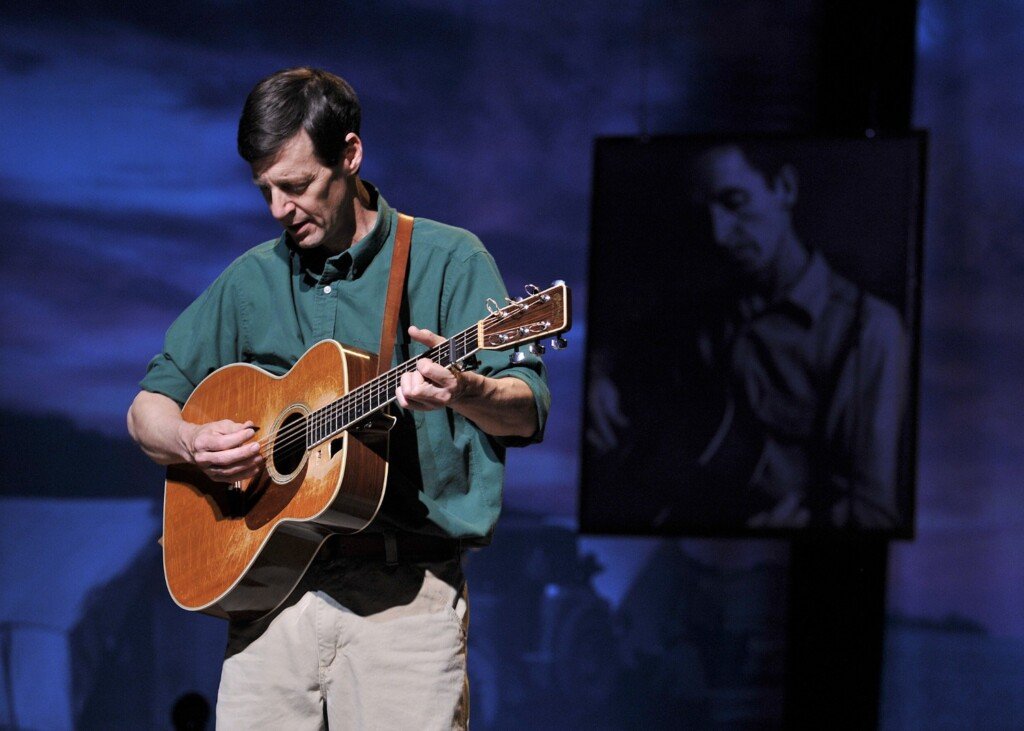
Woody Guthrie’s songs have echoed across generations, inspiring everyone from Bob Dylan and Bruce Springsteen to Billy Bragg and Tom Morello. But behind the folk icon was a restless storyteller whose humour, compassion and fierce social conscience still resonate today. As the award-winning show Woody Sez: The Life & Music of Woody Guthrie returns to the Edinburgh Fringe almost twenty years after it first premiered there, creator and performer David Lutken spoke to Illustrate Magazine about the challenge of bringing Guthrie’s extraordinary life to the stage, why his music refuses to fade, and what audiences can still learn from one of America’s greatest balladeers.
Woody Guthrie wrote songs that have endured for generations. What do you think is the secret to their lasting power?
The “secret” is his genius at combining elements: borrowing or adapting (and often improving upon) well-known tunes is an important element, but the “lasting power” emanates from his lyrics. He hit a lot of nails on the head!
You’ve been living with Woody Guthrie’s words and music for decades. Has your understanding of him changed over the years, or do you find new layers every time you perform the show?
The answer is both, and I feel very lucky to have had the opportunity. Our “takes” on his songs and my understanding and re-telling of his life’s story is always “in the present”, on stage, so every audience makes it different, and I hope a bit of each and every time comes along into the future.
The show combines more than two dozen songs with Guthrie’s own letters, diaries and autobiographical writing. How did you decide which songs and stories best captured who he really was?
It has been a fascinating process to put together this autobiographical “biography-for-the-stage” from Woody’s own thousands of pages of material. Cast members Darcie, Helen, Andy and I all began the process of “devising” Woody Sez with a lot of knowledge of his music (the original song list was quite long!) and good deal about his life, too. We brought in our director, Nick Corley, as a more objective observer, to answer whether we were sticking to the story in ways that held up, and moved the story forward. There is so much left out of any stage biography that what is left in is a delicate balance made up of difficult choices.
Many people know Woody Guthrie because of This Land Is Your Land, but there’s so much more to his catalogue. Is there a song of his that you wish more people knew, and why?
There are many! I want people to know the variety of his songs: funny, satirical, sometimes really corny, elegiac, anthemic, even tragic .. but all so often simultaneously personal and universal, at a level of brilliance seldom equaled.
I wish that more people knew his song “Pastures of Plenty” because it is both patriotic and critical – like a great play, it “shows” rather than simply telling.
Woody Guthrie influenced artists from Bob Dylan and Bruce Springsteen to Billy Bragg and Tom Morello. What do you think modern songwriters can still learn from him?
He is one of the best there has ever been at what he did. I believe a songwriter or performer of any ilk or genre can always learn from the best. Woody learned from other songwriters like Joe Hill and Harry McClintock, and from performers like fellow Oklahoman and humorist, Will Rogers. I think what modern writers can learn is a bit of the ‘way in’ to people’s attention and understanding. As Woody said: “Change the pen and change the ink – change the way that people think.”
As both the show’s creator and the performer playing Woody, how do you balance historical accuracy with creating an engaging theatrical experience?
Trust your instincts and have a good Director.
One of the joys of Woody Sez is watching four actor-musicians share more than twenty instruments between them. How does that live, collaborative approach shape the atmosphere of each performance?
The collaboration on stage becomes an extension of the writing and assembling of elements: book, music, lyrics, incidental measures, instrumental solos, blocking, underscore – everything. Helen Russell, one of the original cast and co-devisers described the performance ‘atmosphere’ as being a bit like a basketball team knowing one another’s next pass or move or shot before it happens – being able to anticipate far ahead – while running .. from one instrument to the next!
Folk music has always been rooted in storytelling. What can theatre bring to those songs that simply listening to an album can’t?
Folk music is also firmly rooted in live performance, and I hope our show can go a step or two beyond. What I set out to do with “Woody Sez” was to show the story of this remarkable person’s life, his career and his music, and tell not only the stories behind the songs, but the story beneath them.
Woody Guthrie wrote about hardship, injustice and uncertainty, yet his work is also full of humour and hope. Is that balance one of the reasons audiences continue to connect with him today?
I think so, yes: Woody was certainly a performer of his time. All around the world, the 1930s & 40s were filled with “Wit & Wisdom” essayists, singers, playwrights, composers and ‘commentators’ standing upon the shoulders of many previous generations. Woody took the persona of “The Wag” a few steps further after what he saw during the Dust Bowl and the Great Depression, and was not afraid to go where his social, cultural and political awakening took him. His humor is sometimes harsh (for the middle twentieth century), but people knew then, and know now, what he’s talking about: “Folk music ain’t nothin’ but singin’ what’s wrong and how to make it right.”
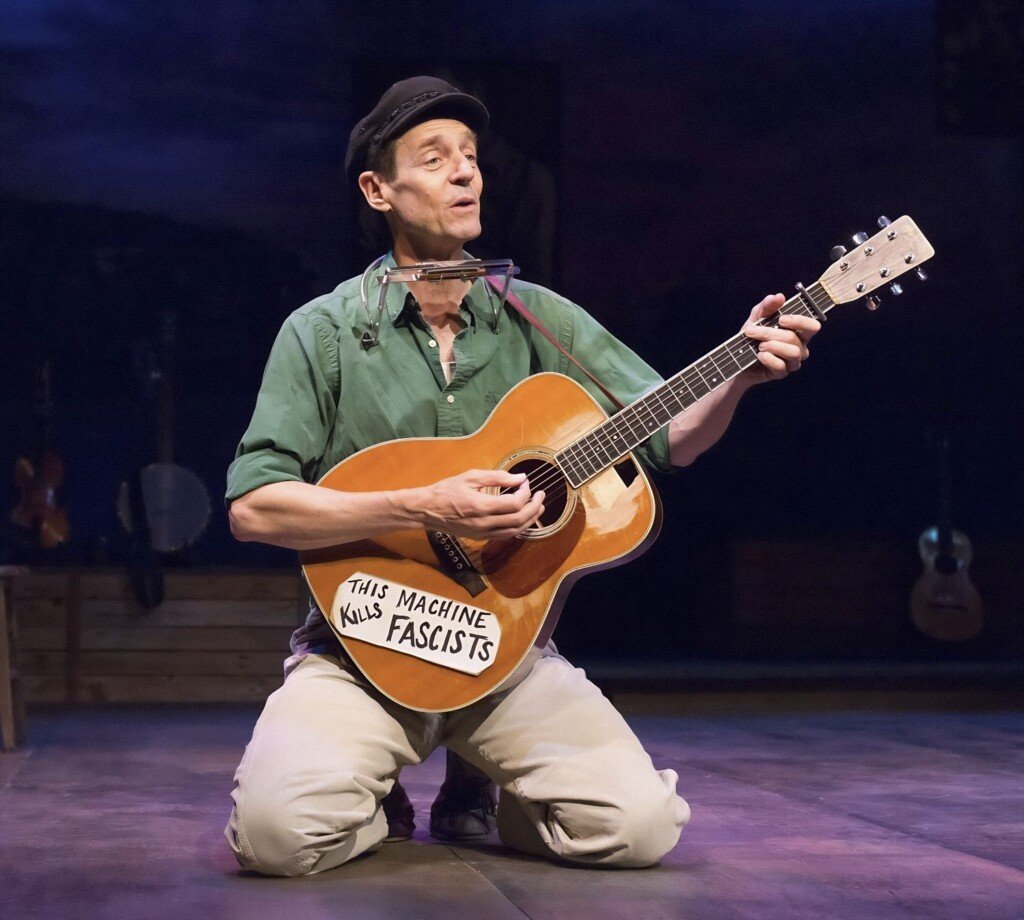
The show first premiered at the Edinburgh Fringe almost twenty years ago. What does it mean to be bringing it back to the festival where this journey began?
It means a lot! It’s a fantastic reunion to be back with the raucous energy of The Fringe that fits the show so beautifully. We’re looking forward to a month-long Hootenanny!
You’ve performed Woody Sez all over the world. Have audiences in different countries responded to Guthrie’s music in different ways, or are the themes surprisingly universal?
Many – if not quite all – of the themes and the jokes are pretty universal, but it is really interesting to see how differently Woody’s topical songs and comments land in different places and with the passing of time – a banking crisis, environmental news, similarities to “soundbites” or political candidates’ words, ideas about immigration, socialism, fascism, and war. Many folks in today’s news are saying: “We need to look past our differences.” I think Woody would agree.
You’ve worked closely with Woody Guthrie’s family throughout the development of the show. Did they share any stories or insights that changed the way you portray him?
The Guthrie family and many in their circle have been a constant support and resource for “Woody Sez”. His former manager, the late Harold Leventhal, first encouraged me to take on the task of putting this show together, and Woody’s daughter, Nora, and now, her daughter, Anna continue to light the way for us, but my most special connection was Mary Jo Guthrie Edgmon, Woody’s little sister. We met in 1990 and became wonderful friends, and she always had a new story to tell. She often told me: “David, you sound just like him, but you’re too tall!”
If Woody Guthrie were writing songs today, what subjects do you think he’d be compelled to write about?
Is this a trick question? (just kidding ..) He’d certainly have a lot to choose from! I think he’d write about everything you’d expect a famous protest songwriter to write and sing about. I also believe he’d be singing about his belief in community and “Communalism” and how that has to be the way forward.
After performing these songs for so many years, is there one moment in the show that still catches you emotionally every single time?
One of the most powerful moments in our show is the song: “Plane Wreck at Los Gatos – Deportees” that Woody wrote in 1948. Another, I have to say, is anytime that our audiences sing along .. gets me every time!
For someone who has never really fully explored Woody Guthrie’s music before, what do you hope they leave the theatre feeling – or perhaps listening to on the journey home?
I hope our theatre audiences leave with the feeling that they’ve seen something unique, that they’ve had a good look at the complicated, brilliant, restless, difficult life of “America’s greatest ballad-maker”, and that they’ve heard some great renditions of his songs – a few that they know, and a few that they didn’t.
One of the first tribute concerts, written in 1956 by one of The Almanac Singers, Millard Lampell, has a spot-on opening line: “He was hot-tempered and stubborn and full of nervous energy and his only fuel, he said, was to be very independent, stand alone, contrive, invent, imagine. And he always believed he had a gift for telling stories with a guitar.”
.. and I hope on the way home, they’ll be listening to our CD!
Woody Sez: The Life & Music of Woody Guthrie will be performed at 5:30pm at Underbelly Bristo Square from 5th – 30th August at the Edinburgh Fringe Festival.
Booking link: https://underbellyedinburgh.co.uk/event/woody-sez
