
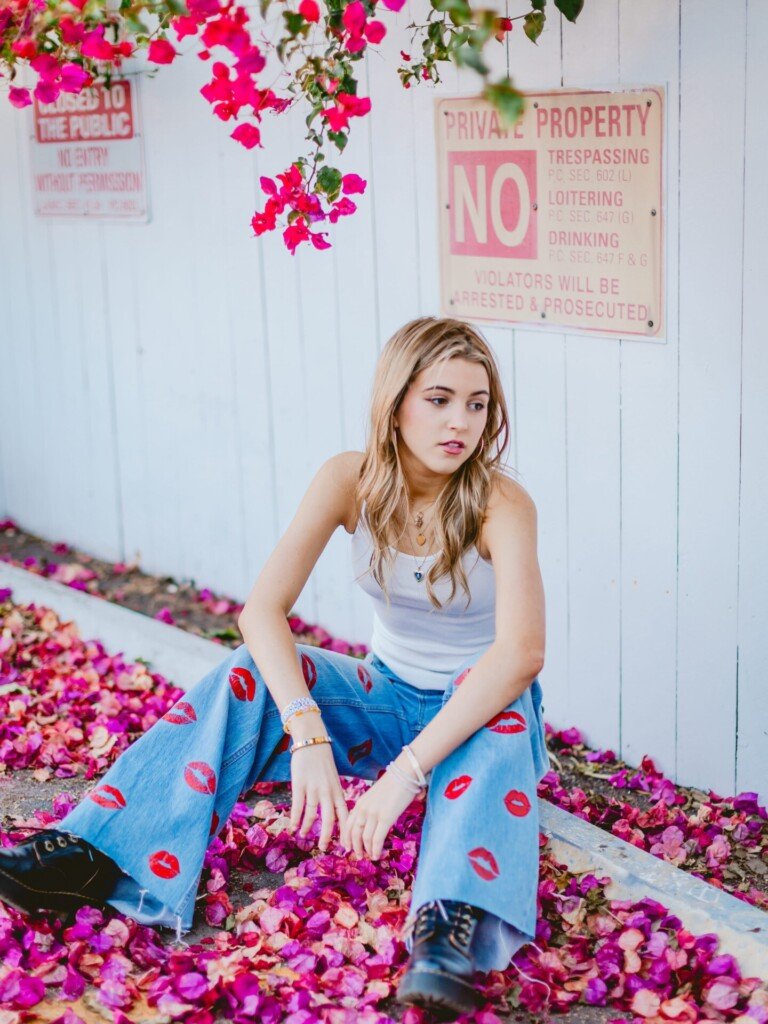
Interview by Zara Miller.
Siena Fantini Is Writing Open-Hearted Pop for the Girls Who Feel Everything.
There is a specific kind of pop artist who knows how to make emotional survival sound like sunlight in a bottle.
For millennials, Natasha Bedingfield did it with songs that felt like opening the windows after crying in your room. Her music had motion, hope, color, and that very early 2000s belief that becoming yourself could be an event worth soundtracking.
Siena Fantini feels like a Gen Z heir to that lineage, but with the settings turned up for a generation raised on therapy, TikTok edits, situationships, parasocial intimacy, and the permanent knowledge that nothing is ever permanent.
Fantini’s music has that same open-hearted brightness, but it is not naïve. Her songs do not float above the mess. They walk straight into it, glitter on their shoes, and start asking uncomfortable questions.
Her new record, Casual Kisser, may sound sunny, but its emotional core is anything but light. Under the catchy hooks and live instrumentation, Fantini is writing about detachment, gendered double standards, fear of intimacy, and the awful little moment when you realize someone else’s care can feel like a cage.
When I ask Fantini whether songwriting has ever forced her to admit something about herself that she “would have preferred not to know,” she immediately points to one song: “Claustrophobia.”
“This is such a good question because I didn’t realize that songwriting could really do that to a person until I wrote Claustrophobia, which is a song I released probably a couple months back. And I just did not know that I felt that way,” she says.
The song began without a clear plan. Fantini was playing chords while going through a situation that made her feel trapped, and suddenly, the lyrics started revealing something before she had the chance to intellectualize it.
“And when I wrote it, I just started playing the chords, and I didn’t really have any intention of what to write about,” she says. “And then I was going through the situation where I felt very trapped, and I started writing it, and I was like, wait, why is this a habit for me? Why. Why are all these words coming out that I suddenly relate to? I didn’t know I related to this, and I didn’t really love it.”
One lyric in particular startled her: “But I hate you for your ease of sharing.”
“I wrote that, and I was like, oh, my God, I do. I do. So weird,” she says.
For a songwriter who had always thought of herself as emotionally available, that realization landed hard. Fantini had assumed that because she wrote vulnerable songs, she must be naturally open. “Claustrophobia” complicated that image of herself.
“The kind of feelings of, like, emotional intimacy, even in, like, friendships or just generally, it’s something that I’ve always thought I was really open to and something I thought maybe because I’m a songwriter, that I’ve always felt very, like, open and willing to share things,” she says.
Instead, the song showed her something she had not fully admitted. Songwriting, for Fantini, does not always come after understanding. Sometimes, it is the thing that creates understanding.
“I don’t always realize it’s how I feel until I write about it,” she says. “Songwriting is a really, like, cathartic experience for me in that sense.”
That instinct makes Fantini’s work feel unusually immediate. She is writing about adolescence while still inside it, which means there is no safe nostalgic distance, no adult narrator smoothing out the chaos from ten years away. She is not writing about being young as a concept. She is writing from the eye of the storm.
When I ask whether she ever feels pressure to convert an experience into art before she has actually lived through it, she says no.
“I don’t think I ever feel pressured because songwriting is my natural response to things. That’s how I process my life,” she says.
Still, she knows some emotions require a little space before they can become songs.
“Sometimes I think naturally I tend to take distance from writing a song about something if I, if I just went through it, um, because it takes a minute for me to be able to fully understand how I felt about it or fully understand what situation meant in its full capacity with more, more of the emotional ones,” she says.
There is a patience in that, even when the songs themselves feel urgent. Fantini is not trying to rush herself into a finished emotional statement for the sake of content. She wants the song to be true, which sometimes means waiting until the feeling has named itself.
“I don’t want to write something if I’m not fully understanding how it feels yet, or I’m not able to quite label it because like I said earlier, I find the labels through my, through my music, and I can’t find the label. I don’t even know what I’m feeling yet,” she says.
The result is songwriting that feels personal without becoming precious. Fantini is not afraid of specificity, and she is not especially afraid of being misunderstood. When I bring up the difficult contradiction in “Claustrophobia” — that being cared for can sometimes feel like being trapped — and ask whether she worried listeners might interpret that as ungrateful, she does not seem particularly concerned.
“Honestly, I don’t think I was worried about that,” she says. “I’ve never really feared misinterpretation, because the whole point of music is to interpret it.”
That outlook took time to develop. Fantini admits she used to censor herself while writing, especially when a lyric felt too exposed.
“It used to be a huge problem for me when I wrote that. I’d, like, I’d write a lyric, and I go, oh, that’s too much. I can’t write that,” she says. “And it’d be a lyric I loved, and it was good, and it was. It served the song well, but I just was like, oh, it’s. You know, it’s going to be misinterpreted, and someone’s going to think that. And no one’s thinking. No one’s thinking that.”
Now, she sees interpretation as one of the best parts of releasing music.
“If I release something, it’s not really mine anymore. It’s for somebody else to apply to their own experiences,” she says.
Fans have already started doing that. Fantini says she receives messages from listeners on Instagram and TikTok who connect to her songs in ways she did not expect.
“My favorite thing is when someone DMs me, like, oh, my God, I’m going through this, and I listen to your song, and I relate to it in this kind of way,” she says. “And I’m like, that’s not what I wrote it about. But you can interpret that way. And that’s so cool to me.”
Even if those messages are not constant yet, she remembers them.
“I remember every single DM I think I’ve ever gotten about my music,” she says.
Her first real fan moment came from TikTok. Fantini was at home scrolling when she was tagged in an edit made by a girl named Ruby. The video used photos from Fantini’s Instagram and was set to “About You” by The 1975, one of her favorite bands.
“I screamed,” she says. “Someone made an edit about me!”
It is a very Gen Z rite of passage: not a scrapbook, not a letter, not someone waiting outside a venue, but an edit. Ruby now runs a fan account, and Fantini still speaks about the moment with delight.
“That’s the first time I’ve ever noticed someone on a social media platform who wasn’t a friend who knew my music, which was super cool,” she says.
That connection between artist and listener matters to Fantini, partly because she grew up as a fan herself. She understands what it means to build pieces of your identity around artists who seem to articulate something before you can.
When I ask whether being a role model is something she wants, she does not reject the idea. In fact, it matters to her.
“I really do hope that some, somebody out there can view me as a role model someday,” she says. “It is important to me.”
She cites Taylor Swift as an early role model, especially during the 2012 to 2014 era of her childhood, and now looks up to artists like Lizzy McAlpine and Jeff Buckley. The idea of being looked up to does not seem to inflate her ego. It seems to make her more aware of the responsibility of being honest.
“I have looked up to artists my entire life,” she says. “Having those role models has been so formative in my life.”
That may be why Fantini’s music carries both confidence and care. She wants to be truthful, but not careless. Raw, but not cruel. Vulnerable, but not manufactured into an aesthetic of pain.
That balance is clearest on Casual Kisser. The song is bright, catchy, and built for singing in the car, but it is also much more cutting than it first appears. Fantini used to think sad lyrics had to live inside sad songs. Now, she loves the shock of realizing a bop has teeth.
“I used to be, like, solely a ballad writer,” she says. “I could never write upbeat songs.”
That changed as she listened to more music and discovered songs that hid emotional devastation under movement.
“If you, like, heard it on the radio and you’re bopping your head to it in the car, and then you look at the lyrics later, you go, oh, my God, this is sad. That’s my favorite kind of song,” she says. “Because it takes you by surprise.”
She calls it “an intentional sense of shock value,” but not the cheap kind that exists just to provoke a gasp. For Fantini, the contrast has to serve the song.
“In regards to casual kisser, that song is so. It’s relatable in a sense where, like, you can have so many aspects of the way you view it,” she says.
On one level, she says, there is something almost funny about the behavior the song describes.
“If you date someone or if you’re, you know, with someone or know of you have guy friends who are just hovering around, it can be kind of funny and it can be kind of. It can be kind of like, oh, my God, what a. What a. What a. What a weird guy,” she says.
But then the song widens into something more cultural: the way men are allowed to detach, move on, and remain unbothered, while women are punished for doing anything similar.
“What a. Unfortunate that men can go just about and do that, and then it’s. And then it’s totally normalized,” she says. “But then the minute a woman moves on too fast, suddenly the worst thing in the world.”
There is the Bedingfield comparison again, but inverted for a new generation. Bedingfield’s best-known songs often made self-expression sound liberating, even triumphant. Fantini’s songs still believe in expression, but they know confession does not automatically set you free. Sometimes it just gives you a better vocabulary for the trap.
“When you’re the one going through it or when you’re the one in a relationship with somebody who just can move on that fast, it can be really cutting,” Fantini says. “And it can be really, like. It can make you question yourself and your worth.”
That is the emotional contradiction at the center of Fantini’s music. The songs are often bright because the experience itself is not one thing. A situation can be ridiculous and devastating. A person can be laughable and still hurt you. A melody can bounce while the lyric bleeds.
“I think that there’s a way to, like, incorporate sonic value with lyrical value and. And to show that kind of complexity,” she says. “The song is so upbeat and so catchy to sing in the car. But when you really think about it, that’s. It hurts because it’s. It seems so simple, but it’s not.”
Fantini’s commitment to specificity is part of what keeps the songs from becoming generic teen-pop approximations written by people who half-remember youth and fully remember marketing strategy. On songs like “Pop Tart,” she leans into details that feel lived-in.
“I do love visceral songwriting that feels tangible,” she says.
She has heard the argument that making lyrics too specific limits relatability. She does not agree.
“I’ve heard, growing up, even just in regards to other songs that, like, oh, the more specific it is, the harder it is to relate,” she says. “But I think the more specific it is, the easier it is to relate.”
That specificity has consequences. Occasionally, people recognize themselves in the songs.
“I’ve definitely had a couple people reach out and be like, hey, is this song about blank? And I’m like, how would you know? And they go, it was there. It was me. And I’m like, okay, well, you have a song about you,” she says.
When Fantini does need advice about whether a lyric reveals too much, she turns to the people closest to the situation: friends who know what she has been through, and often her mother.
“Sometimes my mom, because I tell my mother everything and she knows everything I’ve been through in every single, like, situationship. Not a situation. Things that I’ve … That I’ve ever experienced, and I tell her everything,” she says.
Still, she usually keeps the lyric.
“I don’t really tend to take out those lyrics because I. I think those are. If anything, it’s kind of. It’s kind of cathartic for me to be able to. To admit things so truthfully and so honestly,” she says.
That honesty also has to survive the studio. Fantini’s collaborators have worked with major artists, but her songs still need to sound like her inner life, not a professional adult’s idea of what a teenage girl might feel if she were optimized for streaming platforms. Mercifully, Fantini seems very aware of that danger.
Her solution is partly emotional and partly musical. She communicates clearly with collaborators, provides references, and makes sure the songs stay grounded in live instrumentation.
“I really tend to make sure that instrumentally stuff still feels raw,” she says.
Even when she is working in the pop world, Fantini wants something organic inside the production.
“I don’t think there’s any song that I’ve released and that I have been working on that isn’t. Hasn’t been touched by a layer of, like, Earth,” she says. “Because that’s the way it feels the most authentic to me.”
“Casual Kisser,” for example, includes live-recorded acoustic guitars and piano.
“Nothing is fully produced without anything natural on it,” she says.
Fantini credits producer Sean Hurley, who has worked with Lana Del Rey, as one of the collaborators who understands how to protect the heart of the song. She describes him as someone with a broad musical vocabulary and a strong sense of how different influences can meet without swallowing the artist.
“He’s very, very knowledgeable in the holistic scope of music,” she says.
More importantly, she says, he understands the music as hers.
“When he, from what I’ve noticed, works on a project with me, he makes sure that the music stays authentic to what I do and what my message is,” she says.
Fantini sees Hurley as someone who recognizes that her songs can carry heaviness while remaining rooted in the teenage experience she is actually writing from. Her music may evolve as she ages, but right now, it belongs to this moment of her life.
“I think he recognizes that the music can have layers of heaviness, but it’s still rooted in, like, a teenage experience,” she says.
She also speaks about him with real affection.
“At his core, he’s an incredibly empathetic and kind, kind man,” she says. “I look up to him very much because he’s also kind of a father figure in. In my life.”
In an industry where young artists often collect horror stories before they collect plaques, Fantini’s experience with collaborators has been unusually positive.
“I have not a single horror story about anyone I’ve worked with,” she says. “Everyone’s been so, so kind.”
At 17, Fantini is still at the beginning of her career, but she already speaks with the clarity of someone who understands what she wants her music to protect. Not perfection. Not coolness. Not even mystery, really. She wants to protect sincerity, which is much harder than it sounds, because irony has turned into the default setting for half the planet and sincerity is apparently now a hazardous material.
That sincerity comes through even when the conversation turns away from music. Fantini talks about her cats, Suki and Stormy, her dog Koa, and the fact that she was “raised on the Warrior Cats books” and was convinced until at least age seven that she was a cat. She admits she likes Cats the musical more than the average person does, though she also gets “a little bit, like, off put” watching it. Relatable. That production has haunted stronger civilizations.
Her current favorite movies are the Diary of a Wimpy Kid films. She recently rewatched all three and is firm in her allegiance.
“Rodrick Rules is my favorite. I’ll Die on that Hill,” she says.
For Fantini, this is not just a cute fact. It connects to something bigger: the importance of staying loyal to the things that made you happy when you were younger.
“Staying Connected to your youth is so important because when you’re, when you’re like a teenager, it’s so easy to be like, I can’t wait to move out and grow up,” she says.
She still plays Minecraft with her friends. She has a Minecraft dolphin keychain in her purse. She still loves Frozen and Minecraft: Story Mode.
“I always, no matter how much I grow, like, I will always try to stay rooted in the things that are important to me,” she says.
Then she delivers perhaps the most endearing mission statement of the entire interview.
“When I’m 48, I will assure you that I’m still gonna re watch Diary of a Wimpy Kid,” she says.
That is the thing about Siena Fantini. She is not trying to outrun being young. She is not embarrassed by it, and she is not flattening it into a brand. Instead, she is paying attention to it while it is happening: the contradictions, the friendships, the fandoms, the heartbreak, the songs that begin as journal entries and end as something other people can live inside too.
As for what comes next, Fantini is already preparing new music. She recently recorded songs at EastWest Studios in Los Angeles, specifically Studio 3, where Pet Sounds by the Beach Boys was recorded.
“I just recorded a couple of songs at East West Studios in LA, which is such a dream to be able to admit,” she says.
The masters are already back, and the release is coming soon.
“I have music coming soon that I’m incredibly proud of,” she says.
That sense of excitement feels earned. Fantini is still young, but her writing already understands something many older artists spend careers circling: the brightest songs are not always the least wounded. Sometimes, the brightness is how the wound announces it survived.
Like Natasha Bedingfield before her, Siena Fantini knows pop can be generous, open, and full of forward motion. But Fantini’s version belongs unmistakably to Gen Z: more self-aware, more emotionally specific, more willing to admit that freedom and fear often arrive in the same chorus.
Her music smiles. It also tells the truth.
A good pop song can do both.

You can listen to Siena’s “laundry list” here: https://vyd.co/LaundryList
Connect with Siena here: